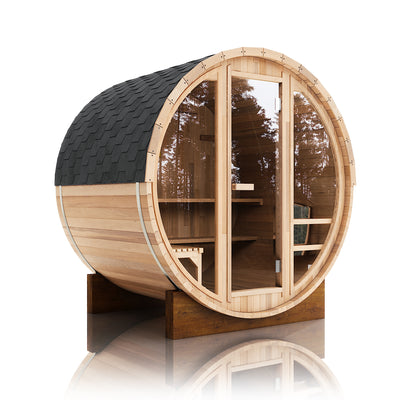
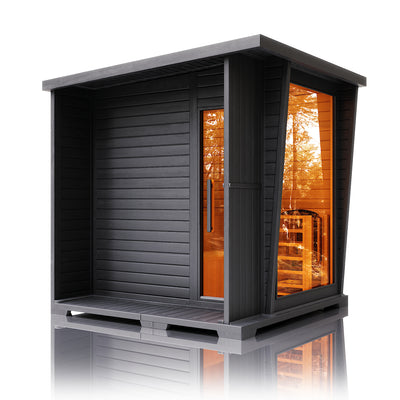
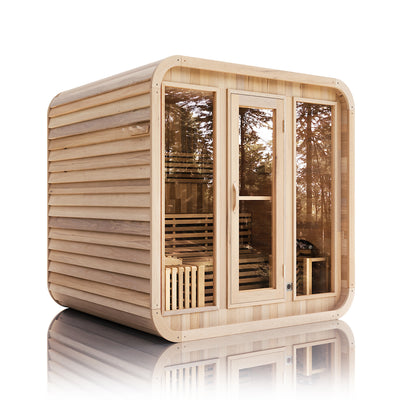
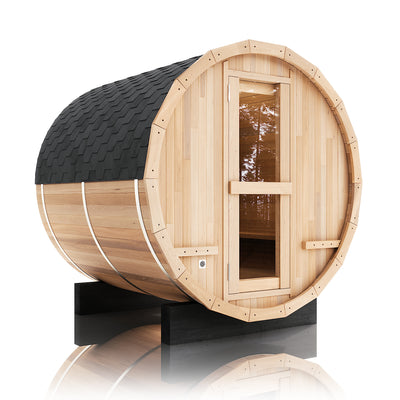
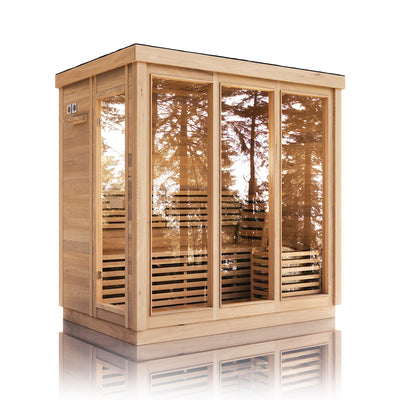
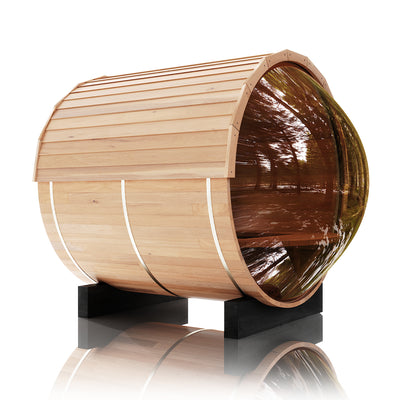
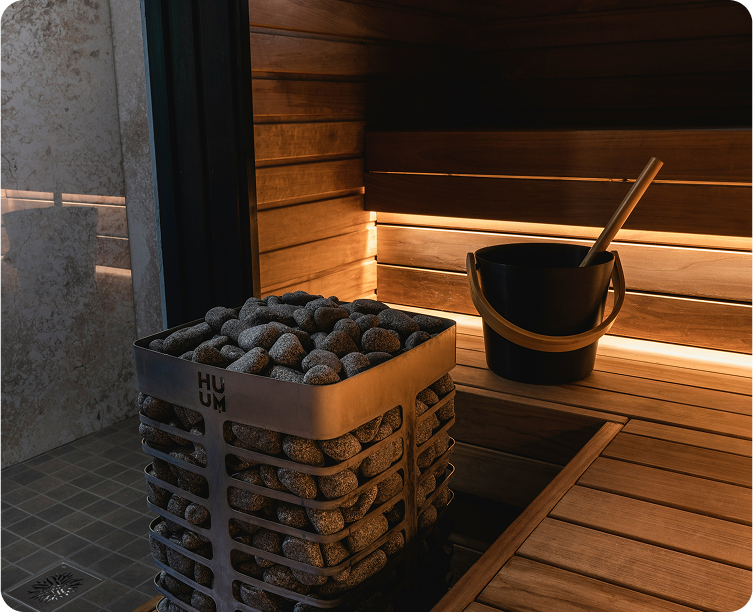
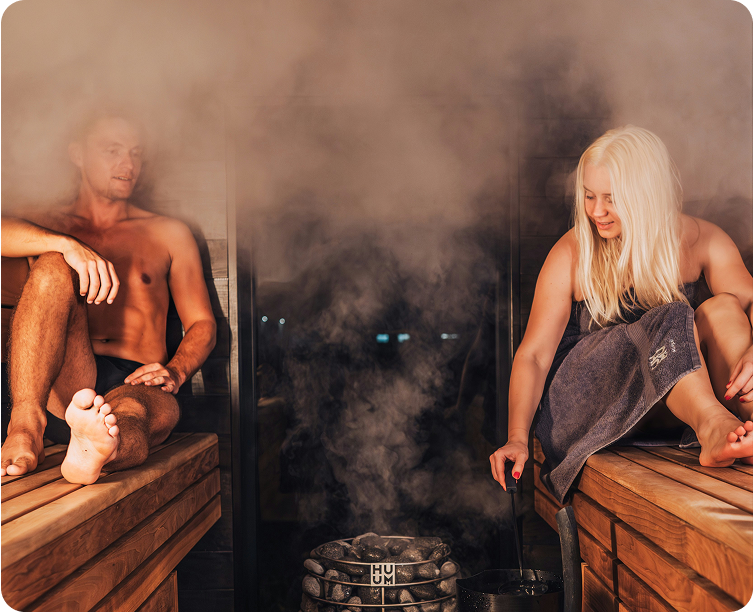
The cube sauna vs barrel sauna decision comes down to how you value interior geometry. A cube or rectangular cabin generally provides more usable headroom, vertical walls, and greater freedom for upper and lower benches. A barrel sauna uses a curved shell to reduce unused heated volume, create a distinctive backyard profile, and support a simple face-to-face seating layout.
Neither design is automatically hotter, more efficient, or more durable. Heater sizing, ventilation, glazing, wood construction, roof protection, sealing, bench height, and installation quality influence performance more than shape alone. A well-designed barrel can deliver excellent traditional heat, while a poorly planned cube can waste its height. A properly built cube can offer superior heat zones and seating flexibility, while an oversized barrel may still feel restrictive near the curved walls.
This guide compares usable headroom, heat distribution, seating, installation footprint, weather exposure, aesthetics, maintenance, cost, and buyer preferences. It also explains how to read capacity claims and technical drawings so homeowners can choose the design that works in everyday sessions rather than simply selecting the shape that looks best online.
Quick Verdict
Choose a cube sauna if you prioritize standing room, tiered benches, predictable shoulder space, a modern architectural appearance, or comfort for users of different heights and heat preferences. Choose a barrel sauna if you want an iconic outdoor form, long opposing benches, efficient curved volume, straightforward kit construction, and a social layout that feels intimate rather than room-like.
For most buyers seeking the strongest combination of ergonomic seating, heat-zone choice, and long-term flexibility, a well-designed cube sauna is the better all-around design. A barrel remains the better emotional and spatial fit when its curved aesthetic is central to the backyard plan and the household primarily wants seated, face-to-face sessions.
|
Decision Factor
|
Cube Sauna
|
Barrel Sauna
|
| Usable headroom |
Consistent across most of the interior |
Highest at center; lower near curved sidewalls |
| Bench options |
Best for upper, lower, L-shaped, or U-shaped layouts |
Usually opposing single-level benches |
| Heat behavior |
Supports intentional vertical heat zones |
Compact curved volume; zones depend heavily on bench height |
| Footprint |
Rectangular and easy to align with patios |
Compact visual mass but cradle width and roof cover matter |
| Weather strategy |
Conventional roof and wall detailing |
Curved staves expand and contract; roof cover may be advised |
| Aesthetic |
Modern cabin or small architecture |
Traditional, sculptural backyard landmark |
How We Evaluated Cube and Barrel Saunas
This is a research-based commercial guide prepared for Rodeo Wellness readers. It does not claim that every listed configuration was physically tested side by side. The evaluation draws on current manufacturer specifications, published heater and ventilation guidance, bench-planning principles, and the practical installation and ownership differences created by each shape.
The analysis gives the greatest weight to usable interior space, bench geometry, temperature choice, heater matching, weather protection, site fit, maintenance, installation access, and expected occupancy. Product dimensions and included equipment can change, so buyers should verify the exact technical drawing, heater manual, electrical requirement, roofing package, warranty, and delivery format before ordering.
Rodeo Wellness sells both cabin-like and barrel outdoor saunas and is included in the recommendation. Readers should consider that commercial relationship. The conclusions remain conditional because individual models vary: a thoughtfully engineered barrel can outperform a weak cube, and a compact cube with excessive glass can demand more heater output than its exterior dimensions suggest.
What Counts as a Cube Sauna
The term cube sauna is used broadly for outdoor cabins with flat or nearly flat vertical walls and a rectangular floor plan. Some are literal boxes; others have sloped roofs, rounded exterior corners, panoramic glass, or a modern pod-like profile. The defining functional feature is that the sidewalls remain substantially vertical through the seating and standing zones.
Vertical walls preserve shoulder width and allow benches to be installed at different heights. They also make it easier to place backrests, lighting, vents, windows, and heater guards on predictable surfaces. Taller cube designs can provide an upper bench where bathers sit closer to the ceiling, which is important because the hottest air naturally collects in the upper part of a traditional sauna.
A cube should not be judged by exterior height alone. Interior ceiling height, roof assembly, bench elevation, heater clearance, floor platform, and the distance above the upper bench determine whether the height is useful. Harvia's bench guidance recommends approximately 1,100 to 1,200 millimeters between the upper bench and ceiling, with less potentially suitable for shorter users. Excess space above heads can leave desirable heat unused.
What Counts as a Barrel Sauna
A barrel sauna forms its room with curved staves held around circular or partially circular end walls, usually by stainless steel bands. The structure sits on cradles and may include a recessed entrance, small porch, panoramic rear window, or canopy benches. Its most recognizable feature is the rounded roof-and-wall shell rather than a separate flat wall and conventional roof system.
The curve reduces corners and can limit the amount of air far above seated users. Manufacturers often describe this as efficient heated volume, and a correctly sized heater can warm the compact room effectively. However, the center ceiling height does not translate to equal headroom across the cabin. Taller users near the sides may feel the curve, especially when benches are wide or raised.
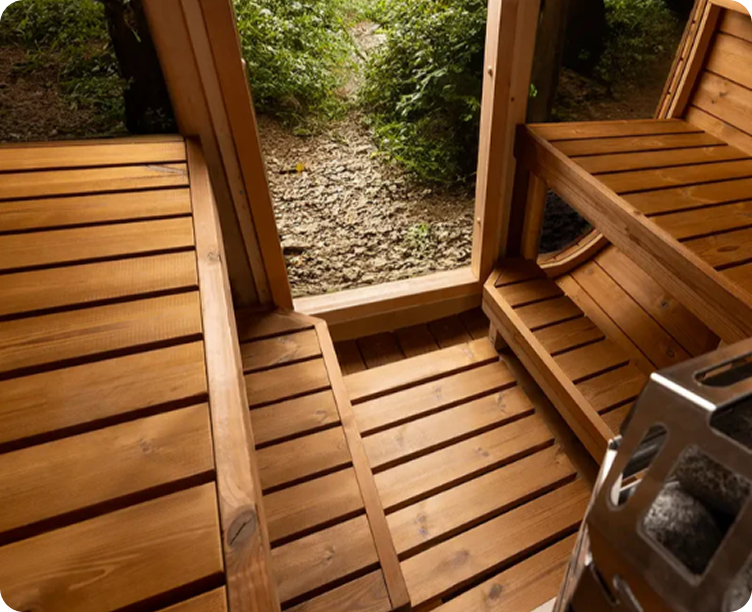
Most residential barrels use two opposing benches along the length. This layout encourages conversation and lets one or two users recline when bench length permits. It is simple and social, but usually provides less vertical temperature choice than a cube with two bench levels. Some larger barrels add raised platforms or creative seating, so buyers should evaluate the actual interior rather than assume every barrel is identical.
Usable Headroom
Headroom is the clearest geometric advantage of a cube. Because the walls rise vertically, an adult can stand or sit close to a sidewall without losing shoulder and head space. The usable width at eye level is close to the floor width, aside from insulation, cladding, and furnishings. This makes the published footprint easier to translate into real interior comfort.
A barrel reaches its maximum height only along the centerline. Moving outward reduces ceiling height and upper-body clearance. This does not make a normal barrel uncomfortable; most users sit along the sides with their heads angled toward the taller center. It does mean that exterior diameter can overstate how much of the upper volume feels usable.
Headroom matters during entry, towel handling, cleaning, heater service, and busy group sessions. A low barrel can feel cozy for seated use but awkward when several adults change places. A cube offers more forgiving movement. Buyers over six feet tall should compare interior cross-sections, bench height, and the head position of a seated user rather than relying on total exterior height.
How to Compare Headroom Accurately
Request a dimensioned interior drawing. For a cube, locate the finished ceiling, upper bench, lower bench, and walking floor. For a barrel, locate the bench surface relative to the widest point of the circle and measure the head envelope above a seated adult. Photographs taken with wide-angle lenses can make both designs appear larger than they are.
Heat Distribution and Temperature Zones
Hot air rises in both shapes. A cube with an elevated upper bench lets bathers place their bodies in the hotter part of the room, while a lower bench offers a milder position. This vertical choice can be valuable for couples with different heat tolerance, families, and guests who are new to traditional sauna bathing.
A barrel's curved ceiling can help guide heated air around the compact room, but shape does not erase stratification. When both benches sit low, bathers may experience hot air above their heads while their feet remain in a cooler zone. The heater, stone mass, ventilation, bench height, door openings, glazing, and ambient conditions all influence the result.
Cube saunas can also distribute heat poorly if the upper bench is too low or the ceiling is unnecessarily high. The design advantage exists only when the benches use the vertical volume intelligently. A well-proportioned cube keeps upper-bench users close enough to the ceiling to occupy the heat, while still preserving safe and comfortable head clearance.
Ventilation must be designed with the heater and temperature sensor. Harvia's current guidance distinguishes mechanical and gravity systems and warns that incoming air should not cool a separate sensor. Buyers should follow the model-specific manual rather than selecting vent locations based only on whether the shell is round or square.
Which Shape Feels More Even
A small barrel can feel enveloping because the room has little unused corner volume and opposing users occupy similar heights. A two-tier cube intentionally creates different zones rather than uniformity. The better experience depends on whether the household wants everyone at roughly the same intensity or wants meaningful choice within one session.
Seating Layout and Everyday Comfort
Cube geometry supports the broadest range of seating. Straight upper and lower benches maximize heat choice. L-shaped benches encourage conversation without forcing users directly opposite one another. Larger cabins can use U-shaped layouts, a separate foot platform, or a changing area. Vertical walls also allow deeper benches without immediately colliding with the shell.
Barrels most often use two straight opposing benches. The arrangement is naturally social and makes efficient use of length. One user can recline on each side when the benches are long enough, although the heater and door may reduce clear length. Shorter canopy barrels trade some interior depth for exterior porch benches and a sheltered entrance.
Bench depth matters as much as capacity. Harvia advises at least 500 millimeters for an upper bench and 600 millimeters or more when users want to lie down or sit with their feet on the bench. Some compact barrels use narrower benches to protect the center aisle, which may feel adequate for upright sessions but less supportive for long relaxation.
Capacity labels should be treated as maximum seated estimates. Compare clear bench length, width per person, heater guard intrusion, door swing, corners, and personal-space preferences. A four-person cube with two levels may offer better everyday comfort for two than a four-person barrel, while a long barrel may be excellent for two adults who prefer to recline.
Installation Footprint
A cube occupies a rectangular footprint that is easy to mark on a patio or foundation. Its corners use the full envelope, which can help align the structure with fences, walls, decks, and modern landscaping. Roof overhang, door swing, steps, service clearance, and drainage still extend beyond the published wall dimensions.
A barrel can appear smaller because its upper half curves inward, but its ground-level project includes cradles, the full diameter, and sometimes a porch or canopy. A rain jacket, shingles, or separate shelter may increase the practical envelope. The rounded form may fit visually into a garden while being harder to place tightly against a straight boundary.
Neither design should be placed by cabin dimensions alone. Add required clearances, local setbacks, access for assembly, electrical routing, a safe landing, roof runoff, cooling space, and room to maintain the exterior. A cube may have a smaller stated width but require wider access for preassembled panels; a barrel kit may arrive as long staves that demand a large staging area.
Small-Yard Planning
In a narrow yard, a compact cube can use a shallow rectangular pad efficiently and maintain shoulder room inside. A short barrel may provide similar occupancy with a sculptural profile, but confirm interior depth after any porch is deducted. Mark both complete envelopes on the ground and walk around them before deciding.
Foundation and Base Requirements
Both designs require a stable, level, manufacturer-approved base. Options may include concrete, compacted pavers, engineered platforms, or structurally adequate decks depending on the product and site. The finished base must support the sauna, heater, stones, occupants, snow where applicable, and concentrated loads without twisting or settling.
Cube panels and doors rely on square alignment. An uneven base can produce wall gaps, door binding, roof-drainage problems, and stress around glazing. Barrels rely on correctly positioned cradles and even band tension. Settlement can change the way staves seat, interfere with the door, and create pathways for water.
Drainage is part of the foundation decision. Surface water should move away from the sauna, and roof runoff should not saturate the base or splash lower wood surfaces. Deck installations need structural review as well as a plan for water, clearances, stairs, and electrical penetrations. Never assume a deck is adequate based only on its age or apparent sturdiness.
Assembly and Delivery
Cube kits commonly use prefabricated wall and roof panels, log-style components, or modular sections. Panels can accelerate assembly but may be bulky and difficult to move through narrow gates. Modular or fully assembled cubes can reduce on-site labor while requiring forklifts, cranes, or unobstructed access.
Barrel kits often consist of end-wall sections, cradles, long staves, bands, benches, and a heater package. The repeating structure is conceptually straightforward, but correct alignment and compression matter. Staves should be assembled according to the sequence and moisture conditions described by the manufacturer, and bands should be adjusted only as instructed.
Before ordering either design, confirm crate dimensions, weight, curbside delivery terms, unloading equipment, gate width, slopes, stairs, overhead branches, and a protected staging area. Delivery risk can outweigh a small difference in assembly time. Obtain professional help when components are too large or heavy for safe handling.
Weather Exposure and Roof Performance
Cube saunas usually use a recognizable roof system: flat-looking membrane roofs, pitched roofs, shingles, metal roofing, or another layered assembly. The conventional form can manage rain and snow predictably when slopes, edges, flashing, penetrations, and drainage are detailed correctly. A nearly flat roof still needs the manufacturer-specified fall and membrane care.
A barrel's curved shell naturally sheds some water, but the stave joints continuously expand and contract with humidity and temperature. Manufacturers may offer shingles, a marine-grade rain jacket, or another approved cover to protect the upper portion. Almost Heaven, for example, offers UV-resistant rain jackets intended to repel water from the top of its barrel saunas.
Weather resistance is a complete system, not a wood-species claim. End walls, glass, door frames, fasteners, roof edges, base clearance, ventilation, and site drainage all matter. Cedar, spruce, hemlock, and thermally modified woods have different appearances and properties, but none compensates for standing water or neglected roof details.
Snow, Sun, and Wind
Cube roofs need appropriate snow-load and drainage planning for the region. Barrels need an approved weather package and clear instructions for snow accumulation. Strong sun can fade either exterior and heat large glass areas; wind-driven rain tests openings and roof edges. Place the sauna and select finishes with the actual exposure in mind.
Maintenance Differences
Interior maintenance is similar across shapes. Users should keep benches clean, avoid harsh chemicals, inspect heater stones, clear vents, and allow the room to dry after sessions. Towels help reduce sweat and soil on benches. Manufacturer-approved cleaning is preferable to aggressive sanding or sealing inside the heated room.
Cube exteriors require roof inspection, finish care where specified, checks around windows and doors, and attention to lower wall splashback. Flat wall planes are easy to access, while tall glass and roof edges may require safe equipment. Drainage debris should be removed before it traps moisture near the structure.
Barrels add band and stave awareness. Wood movement is normal, but adjustments should follow the manual rather than guesswork. Owners should inspect the top weather covering, end-wall joints, cradle contact, door alignment, and any gaps that appear through seasonal change. Over-tightening bands can be as unhelpful as ignoring them.
A cube generally offers the more familiar building-maintenance pattern. A barrel asks the owner to understand a specialized wood shell. Neither is difficult when maintained routinely; both become expensive when water management is postponed.
Aesthetics and Backyard Integration
Cube saunas read as small architecture. Clean planes, dark cladding, vertical wood, broad glass, and sloped roofs pair naturally with contemporary houses and structured patios. The shape can echo an addition, pool house, or garden studio. It also creates flat surfaces that can dominate a small yard if scale and color are not considered.
Barrel saunas read as objects in the landscape. Their curved profile references traditional cooperage and immediately communicates outdoor sauna use. They suit cabins, lake homes, rustic gardens, and owners who want the sauna to become a focal point. A barrel can also contrast effectively with modern architecture when the placement is intentional.
Glazing changes both designs. Panoramic cube fronts make the interior feel open but increase privacy and heater-sizing considerations. Circular barrel windows frame a dramatic view and visually extend the room. Orient glass toward the best controlled view, not simply toward the property line or afternoon sun.
Which Design Ages Better Visually
The answer depends on materials and context. A simple cube with durable detailing can remain architecturally quiet as trends change. A barrel has a stronger identity and may feel timeless to buyers who love the form. Choose the shape you want to see every day, then use restrained finishes and landscaping to connect it to the home.
Privacy and Views
Cube walls make privacy planning flexible. Solid side and rear walls can face neighbors while a glass front opens toward a garden. Higher windows can admit daylight without exposing seated users. The rectangular interior also makes screens and changing vestibules easier to integrate.
Barrels commonly offer a glass door, partial-glass door, or panoramic end window. A full circular rear window can create a memorable experience, but the sightline works both ways. Because the end wall is visually prominent, adding an exterior screen later may compromise the feature that justified the upgrade.
Evaluate privacy during entry, cooling, and changing as well as the heated session. Use landscaping, fences, orientation, exterior curtains where appropriate, or a nearby changing zone. Avoid applying unapproved films or coverings to hot-room glass, which may affect performance or warranty.
Heater Size and Electrical Planning
Shape alone does not determine heater output. The calculation begins with interior volume, then accounts for uninsulated surfaces such as glass, wall construction, ambient climate, and manufacturer rules. A cube with panoramic glazing may need more heating capacity than a smaller opaque barrel; a large barrel with a full glass end may also impose a significant load.
Traditional residential electric heaters often require a dedicated 220-240V hardwired circuit. Breaker, conductor, control, sensor, disconnect, lighting, and grounding requirements depend on the exact equipment and local code. The outdoor route may require trenching and exterior-rated components, so obtain an electrical estimate before comparing product value.
Do not oversize a heater casually. Clearances, sensor positions, controller compatibility, and room-volume ranges are safety and performance requirements. Send the final sauna drawing and heater documentation to a licensed electrician and confirm the approved pairing with the seller or heater manufacturer.
Energy Use and Warm-Up Time
Barrels are often marketed as faster to heat because their curved shell reduces unused corners and upper volume. That can be true when comparing similar construction, glazing, climate, and heater output. It is not a universal guarantee. Air leakage, door openings, wood temperature, ventilation, insulation, stone mass, and target conditions can outweigh shape.
Cube saunas may contain more air, but well-insulated panels and correct bench placement can use the volume effectively. The upper bench allows users to sit in the hottest layer without raising the entire room temperature as much as someone seated low might expect. A compact cube with modest glass can be highly responsive.
Energy comparisons should use the exact heater rating and real warm-up duration. Multiplying kilowatts by operating hours provides a basic consumption estimate, but thermostat cycling and climate affect actual use. The design used consistently may deliver better value than a theoretically efficient shape that feels uncomfortable or inconvenient.
Comfort for Tall Users and Families
Tall users generally benefit from cube geometry because head and shoulder clearance remains available near the walls. They can stand more naturally, sit on an upper bench, and move around the heater without leaning toward the center. Verify the upper-bench-to-ceiling distance and door height rather than assuming every cube is generous.
A large-diameter barrel can also serve tall users well, especially when benches are positioned to place heads toward the centerline. Bench length may be excellent for reclining. Problems arise in compact barrels where narrow diameter, high benches, and wide bodies compete for the same curved space.
Families often prefer tiered cube seating because experienced users can sit high while children or heat-sensitive adults use a lower position, subject to close supervision and professional guidance. Barrels keep the group visually connected and conversational, but offer fewer passive temperature choices unless users move closer to the door or heater.
Social Sessions and Entertaining
Barrels excel at face-to-face conversation. Opposing benches create a clear social arrangement and make every occupant part of the same group. The narrow central aisle keeps the room intimate. For two users, the long benches can feel spacious when each person takes a side.
Cubes offer more ways to organize a group. L-shaped benches create conversation across a corner, while two tiers let guests choose heat intensity. A larger cabin can provide a changing area, porch, or clearer circulation. The person nearest the door may still need to move when the room is full, so study the entry path.
For frequent entertaining, usable capacity matters more than advertised capacity. Compare bench length per adult, safe heater clearance, the ability to enter without stepping around knees, and the cooling area outside. Rotating smaller groups can be more comfortable than filling either design to its maximum label.
Cost and Total Project Value
Barrel kits can offer strong value because the staves form both walls and roof, and the repeating structure is efficient to package. Optional panoramic glass, premium lumber, canopies, rain jackets, shingles, smart heaters, and professional assembly can move the final price well beyond the base configuration.
Cube saunas may cost more when they use insulated panels, extensive glazing, engineered roofs, multiple benches, or architectural cladding. They can also provide more usable space for the money when the vertical walls and upper bench match the household's preferences. Price per exterior square foot is not a meaningful comfort metric.
Complete project cost includes freight, unloading, foundation, drainage, electrical work, trenching, permits, assembly, roof packages, steps, lighting, privacy screens, and ongoing exterior care. Compare written installed estimates for the actual site. A lower-priced barrel requiring a separate shelter may cost more than a cube with an included weather roof.
Buyer Preferences That Should Decide the Choice
The best design is the one whose constraints align with the buyer. Cube buyers tend to value ergonomics, heat-zone choice, architectural lines, predictable interior width, and multiple seating levels. Barrel buyers tend to value sculptural form, intimate social seating, long benches, traditional outdoor character, and a compact visual presence.
Consider how sessions will actually happen. A solo user who likes to recline may prefer a long two-person barrel. A couple with different heat tolerances may get more value from a two-tier cube. A family with tall adults may prioritize vertical walls, while a lake-house owner may regard the barrel silhouette as essential to the setting.
Maintenance tolerance matters too. Buyers comfortable checking bands and weather covers may enjoy barrel ownership. Buyers who prefer conventional roof and wall detailing may find a cube more intuitive. Neither preference is superficial because it affects whether the sauna is maintained and used consistently.
|
Buyer Profile
|
Better Starting Point
|
Why
|
| Tall users |
Cube |
Consistent head and shoulder room near walls |
| Mixed heat tolerance |
Cube |
Upper and lower benches create distinct zones |
| Couple that likes to recline |
Long barrel |
Opposing full-length benches can give each user a side |
| Modern architectural yard |
Cube |
Flat planes align with patios and contemporary homes |
| Rustic or lakeside setting |
Barrel |
Curved form creates an iconic outdoor focal point |
| Frequent social conversation |
Barrel or L-shaped cube |
Choose face-to-face intimacy or multi-level flexibility |
How to Compare Specific Models
Begin with interior drawings rather than marketing names. Record clear bench length and depth, bench height, ceiling height, walking-zone width, heater position, glass area, door swing, vents, and the number of usable heat levels. Then compare exterior dimensions, roof projection, cradles, porch depth, and required clearances.
Review what the price includes. Heater, stones, controller, sensor, lighting, roof covering, floor grid, backrests, guard, delivery, and assembly may be packaged differently. Confirm the electrical load and whether an upgraded heater changes the breaker or control system. Ask for current lead times and package dimensions.
Finally, evaluate the seller's installation documentation, warranty, replacement parts, and support. Shape is visible, but long-term satisfaction often depends on door hardware, roof details, heater service, and the clarity of assembly instructions. A slightly less dramatic model with complete documentation can be the safer purchase.
Real-World Design Examples
Redwood Outdoors' current Duo outdoor sauna illustrates the compact cube approach. Its listed exterior dimensions are approximately 62.75 inches long, 50.75 inches wide, and 82.75 inches high with trim, and the company offers several heater packages. The narrow rectangular footprint and full-height walls show why cube designs appeal to urban yards and couples.
Harvia's Kaski View 220 illustrates a substantial barrel. It measures roughly 7.22 feet in height, width, and depth and uses two 60-centimeter-deep benches with a full circular rear window. The equal exterior dimensions show the classic barrel envelope, while the deep opposing benches demonstrate the comfort available in a larger diameter.
These examples should not be treated as direct equivalents. They differ in capacity, volume, glazing, weight, and heater options. Their value in this comparison is geometric: the cube preserves rectangular width, while the barrel invests more of its visual volume in the circular form and social opposing benches.
Common Buying Mistakes
Design mistakes usually occur when buyers compare exterior photos without translating them into body position, heat level, and site work. The following errors can be prevented before the order is placed.
Assuming a Barrel Is Always More Efficient
Curved volume can reduce unused air, but insulation, leakage, glass, heater matching, climate, and bench height determine actual performance. Compare the complete specification and expected warm-up conditions.
Assuming Every Cube Has Better Heat
A cube only realizes its advantage when benches use the vertical volume. A low single bench beneath a high ceiling may leave users below the most desirable heat.
Using Exterior Height as Headroom
Roof assemblies, floor grids, bench height, and curved sidewalls reduce usable space. Request finished interior measurements and cross-sections.
Ignoring Bench Depth
Narrow benches can inflate capacity while reducing relaxation. Compare whether users can sit supported, lift their feet, or recline as intended.
Forgetting the Weather Package
Confirm shingles, membrane, rain jacket, flashing, and finish requirements. A base price may not include the protection appropriate for an exposed site.
Measuring Only the Shell
Include cradles, roof projection, porch, door swing, clearances, foundation, electrical access, cooling space, and maintenance access.
Choosing Capacity Instead of Comfort
A maximum label does not guarantee relaxed seating. Use clear bench dimensions and expected body sizes to estimate everyday occupancy.
Frequently Asked Questions
Is a Cube Sauna Better Than a Barrel Sauna
A cube is usually better for headroom, tiered benches, shoulder space, and heat-zone choice. A barrel is often better for iconic aesthetics, long opposing benches, compact curved volume, and intimate social sessions.
Which Sauna Heats Faster
A barrel may heat quickly because it reduces unused corners, but actual warm-up depends on volume, heater output, glazing, insulation, leakage, ventilation, climate, and target temperature. Compare exact models rather than shapes alone.
Which Design Has More Headroom
A cube provides more consistent headroom across the interior. A barrel has maximum height along the centerline and progressively less clearance near the curved sides.
Are Barrel Saunas Comfortable for Tall People
Large-diameter barrels with correctly positioned benches can be comfortable, especially for reclining. Tall buyers should verify head position, bench height, door height, and shoulder clearance from a dimensioned cross-section.
Which Design Has Better Heat Distribution
A two-tier cube provides stronger intentional temperature zones. A barrel can feel evenly enveloping at one seating level, but feet may remain cooler when benches are low. Heater and ventilation design are critical in both.
Do Barrel Saunas Need a Roof
Requirements vary. Some include shingles or another covering; others offer an approved rain jacket or recommend additional weather protection. Follow the exact manufacturer's instructions for the climate and exposure.
Is a Cube Sauna Harder to Assemble
Not necessarily. Prefabricated cube panels can assemble efficiently but may be bulky. Barrel kits use repeating staves and bands but require careful alignment. Delivery access, component weight, and installer experience matter more than shape alone.
Which Design Is Better for a Small Backyard
A compact cube uses a rectangular pad efficiently and preserves vertical room. A short barrel can have a modest visual mass and long benches. Compare the complete footprint, including porch, cradles, roof cover, door swing, and clearances.
Can Both Designs Use Electric Heaters
Yes, when the sauna and heater are approved as a system. Many models use dedicated 220-240V electric heaters. Exact output, breaker, sensor, control, and clearance requirements vary.
Can Both Designs Use Wood-Burning Stoves
Some models offer wood-burning configurations where local rules permit them. Chimney, combustion air, ember protection, clearances, and fire requirements demand professional planning and cannot be inferred from an electric model.
Which Is Easier to Maintain
Cube exteriors use familiar roof and wall details. Barrels require attention to bands, staves, cradles, and the upper weather covering. Interior cleaning and drying are similar. Quality construction and drainage matter more than shape alone.
Which Design Is More Private
Privacy depends on glazing and orientation. Cubes can combine solid side walls with a controlled glass front. Barrels can use solid ends, glass doors, or panoramic windows. Evaluate the route, changing area, and cooling space too.
Which Is Better for Families
A tiered cube often suits families because users can choose different heat levels and vertical walls ease movement. A barrel can be excellent for a close-knit group that values face-to-face conversation and similar heat intensity.
How Much Bench Space Does One Person Need
Harvia notes that about 600 millimeters is a useful rule of thumb for one seated place. Actual comfort depends on body size and desired personal space. Deep benches are more important when users want to recline or lift their feet.
Does Shape Change Electrical Cost
Indirectly. Shape affects volume and heater selection, but circuit length, heater output, trenching, panel capacity, controls, and local labor drive electrical cost. Obtain a quote for the exact model and site.
Editorial Review and Primary Sources
This article was reviewed against current manufacturer information on September 4, 2026. Product dimensions, heater packages, prices, availability, manuals, and warranty terms can change. Confirm the exact configuration and local installation requirements before publication or purchase.
Harvia guidance on choosing sauna benches
Harvia guidance on sauna ventilation
Redwood Outdoors Duo cube sauna specifications
Harvia Kaski View 220 barrel sauna specifications
Rodeo Wellness outdoor sauna collection
Internal Linking Note
Link this comparison to outdoor sauna sizing, foundations, maintenance, heater selection, cedar versus hemlock, two-person and four-person buyer guides, and indoor versus outdoor placement. Keep the page focused on shape and interior geometry so it supports rather than competes with capacity-specific product roundups.
Final Thoughts
The cube sauna vs barrel sauna choice is ultimately a decision about how exterior shape translates into the body position and heat experience inside. Cubes preserve headroom and shoulder width, create room for upper and lower benches, and align easily with architectural patios. Barrels reduce corners, encourage face-to-face seating, and bring a distinctive outdoor identity that many buyers value as much as technical efficiency.
Neither design should be purchased from appearance or capacity alone. Compare finished interior drawings, bench depth and height, the position of seated heads and feet, heater sizing, glass area, ventilation, roof protection, foundation, delivery access, and complete installed cost. The strongest model is the one that resolves these details as a system.
For buyers who remain undecided, prioritize the ordinary session. Choose a cube if different heat levels, tall users, movement, or layout flexibility will matter each week. Choose a barrel if the household will mainly sit or recline along long opposing benches and the curved form is the experience they genuinely want in the yard.
Our Recommendation
For most homeowners, we recommend a cube sauna as the better all-around design. Its vertical walls provide more usable headroom, make capacity easier to understand, support deeper and tiered benches, and offer stronger flexibility as household needs change. The conventional roof and rectangular foundation also integrate predictably with many residential sites.
Rodeo Wellness buyers who want that balance should begin with the brand's modern cabin configurations, then compare them with its compact and panoramic barrel models using actual bench dimensions and site requirements. A cube is particularly persuasive for mixed heat preferences, taller adults, families, and buyers who view the sauna as a permanent piece of backyard architecture.
Choose a barrel instead when the curved silhouette, opposing social benches, and intimate traditional atmosphere are central to the purchase. A well-sized barrel with deep benches, an approved heater, effective ventilation, and a complete weather package can be an outstanding sauna. Cube is our general recommendation, but barrel is the right choice when its specific strengths match how the household will sit, socialize, maintain, and use the space.



 OUR BEST SELLERS