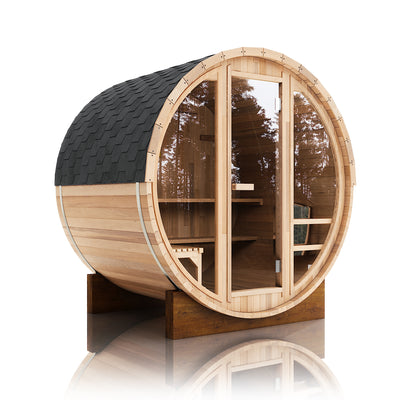
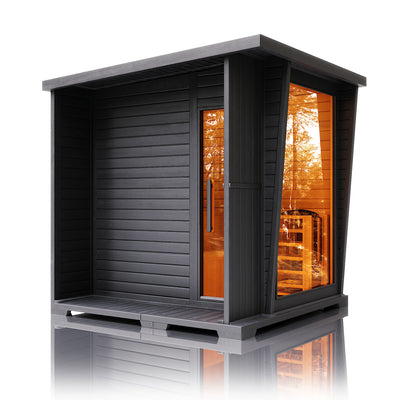
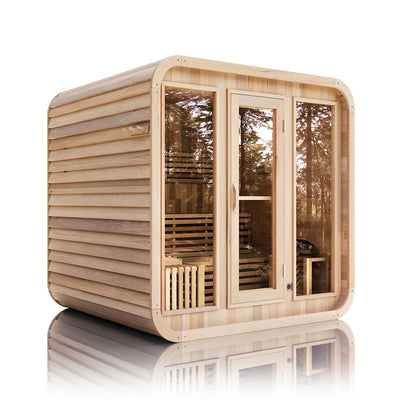
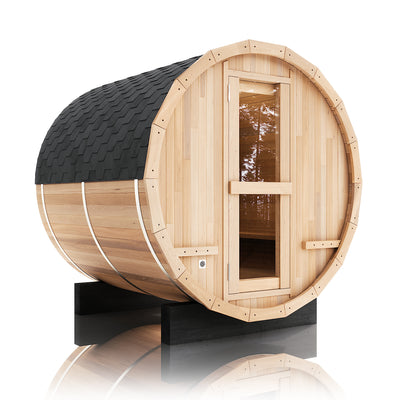
A typical outdoor sauna heat up time is about 30 to 60 minutes for a compact, properly insulated electric sauna with a heater correctly matched to its effective interior volume. Mild weather, a smaller room, limited glass, and a conventional 6 kW heater can place the session near the faster end. Freezing conditions, panoramic glass, a larger cabin, heavy stone capacity, a high target temperature, or a heater working near its maximum approved room size can extend warm-up to 60 to 90 minutes or longer.
That range is a planning benchmark, not a promise. A controller can reach its setpoint before the benches and sauna stones are fully ready, while another sauna may feel comfortable before its display reaches the owner's usual number. Buyers should therefore distinguish air-temperature warm-up, stone readiness, and full-cabin heat soak. The best measurement is the time required to produce stable upper-bench heat and satisfying steam under the household's actual conditions.
This guide explains how heater output, room volume, panoramic glass, insulation, outside temperature, sauna stones, ventilation, door usage, controls, and electrical performance shape the result. It also compares Rodeo Wellness configurations using Toule or Harvia 6 kW heaters and HUUM DROP 6 kW or 9 kW upgrades with the Wi-Fi UKU controller. Exact performance depends on the selected cabin and equipment, so all sizing, installation, and operating decisions must follow the model-specific documentation.
Quick Answer
Plan on approximately 30 to 60 minutes for many residential outdoor electric saunas to become usable, then add margin for severe cold, wind, large glass areas, dense stone systems, and higher target temperatures. If the cabin begins below freezing or has been unused for several days, the air may warm before the wood, glass, benches, and stone mass. Waiting another 10 to 20 minutes after the first target reading can produce a more even session.
A 9 kW heater does not automatically cut the warm-up time of every sauna by one-third compared with a 6 kW model. Heater size must stay within the manufacturer's approved room-volume range. The larger heater is valuable when the calculated load genuinely requires it; installing it in an undersized room can cause rapid cycling, poor stone readiness, harsh heat, clearance conflicts, and electrical complications.
|
Outdoor Sauna Condition
|
Reasonable Planning Range
|
Main Variables
|
| Compact insulated cabin in mild weather |
About 30–45 minutes |
Correct 6 kW sizing, modest glass, closed door, normal target |
| Typical residential cabin |
About 40–60 minutes |
Room volume, stones, target temperature, ventilation, ambient conditions |
| Panoramic or glass-heavy cabin |
About 45–75 minutes |
Effective-volume adjustment, radiant loss, wind, heater reserve |
| Cold-weather start |
About 60–90+ minutes |
Subfreezing structure, wind, snow, leakage, equipment suitability |
| Large-stone HUUM DROP system |
Allow time for stone readiness |
55 kg stone mass, correct stacking, airflow, target and room load |
| Frequent door opening |
Variable and potentially much longer |
Number of users, staging, wind, door alignment, recovery capacity |
What Counts as Fully Heated
Warm-up ends at different moments depending on what is measured. The controller measures at its approved sensor location, often high in the room. A wall thermometer measures only its location. Bathers feel air temperature, radiant warmth from surrounding surfaces, humidity, airflow, and bench temperature together. These indicators do not peak simultaneously.
The air contains relatively little thermal mass, so it can reach the target before the cabin materials. Cold benches continue drawing heat from the room, and a large stone basket may need more time to store enough energy for repeated water application. Entering at the first setpoint can be perfectly acceptable for a quick dry session, but it may not represent the system's best steam performance.
For consistent comparisons, define readiness before timing the sauna. A practical standard is stable temperature near upper-bench shoulder height, comfortably warmed seating surfaces, and clean vaporization from a modest ladle of water. Use the same target, starting condition, and thermometer location whenever testing changes.
Air Temperature Readiness
Air-temperature readiness is the quickest benchmark and the one most control apps display. It is useful for scheduling, but the sensor may be hotter than the occupied zone because it sits near the ceiling. A notification that the setpoint has been reached should be treated as an invitation to check the sauna, not proof that every surface is fully heat-soaked.
Bench and Cabin Heat Soak
A heat-soaked cabin feels smoother and more stable. The walls and benches return radiant warmth instead of absorbing it from bathers, and the room recovers better after the door opens. In deep winter, full heat soak can lag behind the air setpoint by a meaningful interval because the entire structure starts cold.
Stone Readiness
Stones must be hot enough to vaporize water promptly. If water trickles through or produces weak steam, the stone mass may need additional time even when the air looks ready. Stone type, quantity, arrangement, airflow, and heater design influence this interval. Never test readiness by pouring excessive water or touching the stones.
Why a Single Stopwatch Result Misleads
One warm-up result can be distorted by sun exposure, wind, residual warmth from an earlier session, wet wood, door opening, line voltage, or a changed thermometer. Record several sessions across different weather conditions before judging the system. A seasonal range is more useful than a single advertised number.
Heater Size and Heating Capacity
Heater output is the most visible specification, but its effect depends on the load it serves. Kilowatts describe electrical heating power, not guaranteed minutes. A correctly matched 6 kW heater can bring a compact cabin to traditional temperature efficiently, while the same output can struggle in a larger room with panoramic glass. A correctly matched 9 kW unit can provide more capacity for an approved larger load.
Sizing must respect both minimum and maximum room volumes. Undersizing typically causes long full-power operation, slow recovery, and disappointing winter results. Oversizing can heat the air faster than the stones and wood, causing short cycles and uneven heat. It may also violate clearances, electrical requirements, or the heater listing.
Electrical supply matters as well. The HUUM DROP North American documentation shows that nominal output can differ between 240 V and 208 V configurations. A buyer who assumes the same model produces the same output at every supply voltage may form unrealistic warm-up expectations. The electrician should confirm the actual voltage, equipment rating, load, breaker, conductors, controls, and installation.
Toule or Harvia 6 kW Heater
Rodeo Wellness uses Toule or Harvia 6 kW heaters in applicable standard configurations. These conventional wall-mounted systems are well suited to many compact home saunas when the effective room volume falls within the exact heater's approved range. Harvia lists its North American KIP 6 kW model for a defined cubic-volume band, while Toule's 6 kW documentation provides its own range; the supplied model manual controls the final match.
A smaller stone cavity generally allows the room air to rise efficiently, which can support predictable preheat. The precise experience still depends on how the stones are arranged, how the thermostat or separate sensor is positioned, and whether the cabin begins in extreme cold. Mechanical-control models may have specific low-temperature limitations that must be checked before purchase for an unheated outdoor installation.
HUUM DROP 6 kW
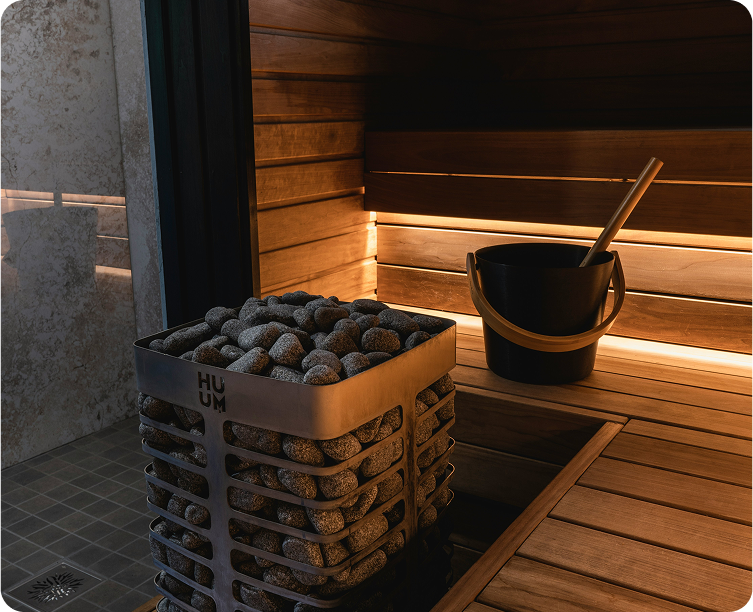
The HUUM DROP 6 kW upgrade combines 6 kW nominal output at its rated supply with a much larger exposed stone mass than many compact conventional heaters. HUUM identifies approximately 55 kg, or 121–122 pounds, of stones for the DROP. That mass supports abundant, softer steam and long heat release, but owners should budget time for the stones to become fully ready.
In a room correctly matched to the DROP 6, air warm-up may be comparable to other 6 kW systems under some conditions, yet full steam readiness can follow a different curve. This is not inefficiency; it is part of the stone-forward design. Buyers who prioritize the fastest possible first temperature reading and buyers who prioritize sustained löyly may evaluate the tradeoff differently.
HUUM DROP 9 kW
The HUUM DROP 9 kW offers greater output for approved larger rooms or higher calculated loads. It can improve cold-weather recovery and reduce the time a properly sized larger cabin spends climbing toward target. It uses the same large stone concept, so sufficient preheat remains important for the intended steam character.
The 9 kW option is not a universal speed upgrade. HUUM publishes different approved room-volume bands and electrical requirements for the DROP 6 and DROP 9, and the bands depend on supply voltage. Select the model from the completed effective-volume calculation and exact regional documentation, not from the desired number of minutes alone.
Wi-Fi UKU Controller
Rodeo's HUUM upgrades use the Wi-Fi UKU controller, allowing owners to start heating in advance through supported app functions. Remote control does not reduce the physical warm-up time, but it changes how waiting is experienced: the sauna can begin heating before the planned session rather than after the user reaches the backyard.
Remote start requires the approved safety configuration, reliable connectivity, and a cabin that is clear of towels, buckets, clothing, or stored objects. The user must understand door-sensor behavior and local requirements. Scheduling convenience should never be achieved by bypassing safety devices or leaving combustible items near the heater.
Compare heater options using these performance questions:
-
Effective load: Does the finished room, including all glass and uninsulated surfaces, remain within the exact heater's range?
-
Supply voltage: Will the installed electrical service deliver the model's stated output for that voltage and configuration?
-
Stone objective: Does the household prioritize the quickest air-temperature rise or a larger stone mass and sustained steam?
-
Winter conditions: Is the heater and control system suitable for the lowest expected starting temperature and exposure?
-
Recovery demand: Will the sauna serve one or two users with limited door opening, or groups entering and exiting repeatedly?
Interior Volume and Ceiling Height
Interior volume establishes the basic heating load. Multiply finished interior length, width, and height, then use the heater manufacturer's procedure to add allowances for glass, tile, masonry, logs, or other uninsulated surfaces. Exterior dimensions are not an acceptable substitute because wall thickness and roof geometry change the occupied volume.
A small increase in each dimension can create a large increase in cubic volume. Raising a ceiling from seven feet to eight feet increases the room load by roughly fourteen percent when floor area remains constant, and much of the added hot air sits above the bathers. Buyers should therefore compare usable bench layout and ceiling height, not simply advertised person capacity.
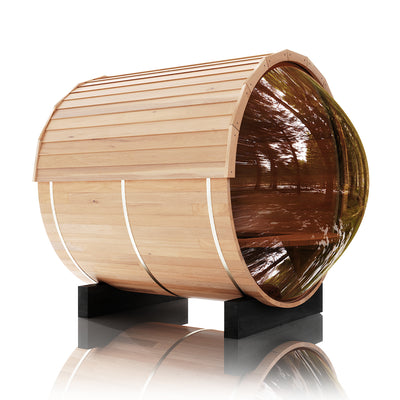
Irregular barrel, cube, and sloped-roof designs require careful calculation. The manufacturer or dealer should provide the approved method rather than forcing the room into an inaccurate rectangular estimate. Porch space, changing rooms, and exterior overhangs are not part of the heated volume unless they are inside the thermal envelope.
Nominal Volume Versus Effective Volume
Nominal volume is the geometric interior. Effective volume is the figure used for heater sizing after heat-loss adjustments. A 250-cubic-foot wood room can behave like a substantially larger room if one wall is panoramic glass. Warm-up expectations should follow the effective load, not the tape-measure volume alone.
Person Capacity Is Not Heater Capacity
A four-person label describes seating assumptions, not thermal demand. Two cabins marketed for the same number of people can differ in ceiling height, glass, vestibules, wall assembly, and bench arrangement. Compare drawings and effective volume before assuming they will heat at the same rate.
The Upper End of a Heater Range
A heater operating near the maximum approved volume may reach the target while offering less reserve for severe cold, repeated door use, or future glass modifications. That does not make the match wrong, but it can move real-world warm-up toward the longer side. The decision should account for climate and use pattern as well as minimum compliance.
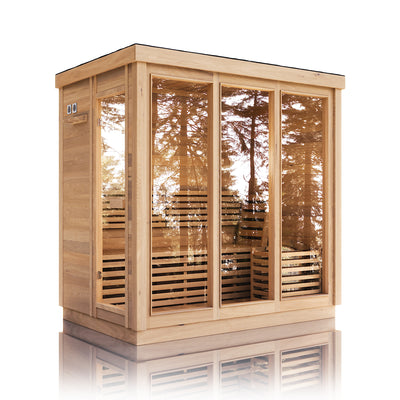
Glass Area and Panoramic Designs
Glass is one of the largest variables in outdoor sauna heat up time. It has far less insulating value than a well-built opaque wall and creates a cold radiant surface in winter. HUUM's DROP documentation instructs installers to add calculated volume for uninsulated glass, brick, or tile, demonstrating why dimensions alone are insufficient.
A full panoramic wall can increase warm-up even when the heater is technically large enough. Wind across the exterior removes heat, and bathers near the glass may feel cooler than the sensor indicates. In summer, solar gain can reverse part of that effect and shorten the initial climb, which is another reason to use seasonal ranges.
Buyers should not avoid glass automatically. Views, daylight, and visual openness may justify the added load. The important step is to price the correct heater and electrical system at the same time as the glass design rather than treating the heater as an afterthought.
Glass Doors
Even a standard glass door contributes to the effective load. Door alignment also matters because air leakage around a poorly fitted panel can exceed conductive loss through the glass itself. Check hinges, catches, safe closing, and seasonal movement while preserving required gaps and ventilation.
Panoramic Walls
Large glass panels increase both heat loss and radiant asymmetry. Bench placement, heater capacity, wind exposure, and target temperature determine how noticeable this becomes. A higher-capacity approved heater can address the load, but it cannot make glass behave like an insulated wall.
Aftermarket Glass Changes
Replacing a wood panel with glass changes the room calculation. Recheck the heater range, sensor environment, structural details, and warranty before modifying the cabin. A heater that was comfortably sized for the original enclosure may sit at or beyond its limit afterward.
Before selecting a glass-heavy design, document:
-
Total glass area: Include every door, window, and panoramic panel rather than estimating by wall count.
-
Manufacturer adjustment: Apply the exact effective-volume allowance specified for the selected heater and market.
-
Wind exposure: Identify whether the glass faces prevailing winter weather or an open waterfront, field, or rooftop.
-
Bench relationship: Consider the comfort of users seated close to cold glass even after the sensor reaches target.
-
Electrical consequences: Confirm whether the adjusted load moves the project from a 6 kW to an approved 9 kW system.
Insulation Air Sealing and Construction Quality
Insulation determines how rapidly heat conducts through the enclosure, while air sealing controls uncontrolled hot-air loss. Both affect warm-up. High nominal insulation is not enough if wind enters around the door, roof joint, conduit, window frame, or wall connection. Likewise, a very tight room still needs planned ventilation for comfort and heater operation.
The ceiling is especially important because the hottest air accumulates near it. Missing insulation or gaps in the vapor-control layer can release heat and carry moisture into cold assemblies. Properly detailed walls and ceiling reduce warm-up time, stabilize temperature, and protect the cabin from condensation-related damage.
Floor construction varies across outdoor saunas. Some designs intentionally use more open airflow, while others have insulated floors. Owners should follow the specific system rather than sealing openings indiscriminately. Altering ventilation or drainage to gain a few minutes can produce worse air quality or moisture problems.
Factory Fit and Field Assembly
Panel joints, roof connections, window gaskets, and door installation depend on accurate assembly. A small alignment problem can become significant in wind. Use the specified foundation, keep the cabin square and level, and complete every seal and flashing detail in the installation instructions.
Moisture and Wet Materials
Wet wood requires energy to warm and dry. Roof leaks, wind-driven rain, poor drainage, or a cabin closed while damp can therefore extend the next preheat. Correct the source rather than accepting progressively longer warm-up as normal aging.
Unauthorized Insulation Modifications
Do not place temporary blankets, foam, or other combustible materials around the cabin or heater to accelerate winter heating. Any enclosure change must preserve listed clearances, drying paths, ventilation, electrical access, and the wall system's moisture strategy.
Outside Temperature Wind and Seasonal Variation
The colder the starting cabin, the more energy is required to warm the air, structure, stones, and contents. Heat loss also increases as the difference between indoor and outdoor temperature grows. A sauna that reaches 180°F in forty minutes on a mild afternoon may need substantially longer during a windy subfreezing evening.
Harvia's current support guidance warns that certain mechanically controlled heaters can experience low-temperature overheat-protector behavior in unheated outdoor saunas. This is model-specific and not merely a warm-up-time issue. Buyers in freezing climates should confirm that the exact heater and controls are suitable for the expected ambient conditions before ordering.
Wind can matter as much as the thermometer. Pressure across the cabin encourages leakage, increases glass losses, and may change ventilation flow. Snow and ice can interfere with doors or vents, while a damp shaded site may keep materials colder. Site planning therefore influences heating performance throughout ownership.
Mild Weather
In mild conditions, the cabin starts closer to the target and loses heat more slowly. Warm-up is often predictable, making this the best baseline for commissioning tests. Record a few normal sessions before evaluating extreme-weather performance.
Freezing Conditions
A freezing cabin needs time for every surface to cross a wide temperature range. Expect the air display to lead bench and wall comfort. Keep vents, roof, and door hardware clear according to the maintenance instructions, and never use an unauthorized space heater or open flame to prewarm the room.
Sun and Site Orientation
Direct sun can warm dark roofing, cladding, or glass before the heater starts, while deep shade may preserve snow and moisture. Solar gain is inconsistent and should not be included as required capacity, but it explains why two otherwise similar afternoon and evening tests can differ.
Sauna Stones and Airflow
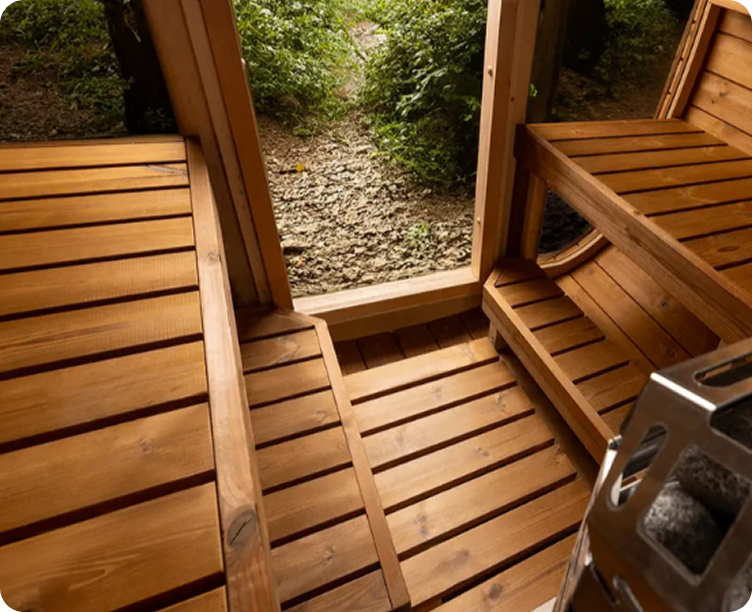
Sauna stones store heat, shield heating elements, shape airflow, and create steam. Their influence on warm-up is a design tradeoff. A smaller correctly loaded stone cavity may raise room air faster, while a large mass takes more energy to heat but supports softer, longer-lasting steam and more stable recovery.
HUUM specifies approximately 55 kg of stones for the DROP and provides size and placement guidance. Stones must be placed individually with space for airflow while covering the elements as directed. Pouring stones from a bag, packing them too tightly, or using unsuitable decorative rocks can restrict circulation and impair performance.
Stones change over time. Thermal cycling can crack them, and fragments settle into airflow paths. Harvia advises periodic rearrangement and replacement of deteriorated stones, with frequency depending on use and heater type. A sauna that gradually takes longer to heat may need a stone inspection rather than a larger heater.
Too Many or Tightly Packed Stones
Excess stone or dense packing can trap heat around elements, reduce convective airflow, slow room heating, and contribute to overheat protection. Use the specified quantity and arrangement rather than adding stones in hopes of creating more steam.
Too Few Stones
Insufficient coverage can expose elements to direct water, create harsh heat, and reduce steam quality. Removing stones to speed warm-up changes the engineered system and is not an acceptable optimization.
Cold Stone Mass
During a winter start, a large mass begins at outdoor temperature and absorbs a meaningful share of heater output. The controller may announce air readiness before the stones deliver their best löyly. Preheating through the UKU schedule can make this waiting less intrusive without changing the underlying physics.
Maintain stone performance with a controlled routine:
-
Correct product: Use only sauna stones of the type and size approved by the heater manufacturer.
-
Correct quantity: Follow the model documentation rather than estimating from appearance or filling beyond the basket.
-
Correct arrangement: Place stones individually, maintain airflow, protect elements, and use required heat-guiding components.
-
Periodic inspection: Remove fragments, rearrange settled stones, and replace deteriorated pieces on the recommended schedule.
-
Realistic readiness: Allow sufficient time for full vaporization before judging the heater by steam performance.
Door Usage Ventilation and Group Sessions
Opening the door releases a large volume of hot air and draws in outdoor air near the floor. The heated wood and stones help the cabin recover, but repeated long openings can add meaningful time. A family staging towels, drinks, and sandals after starting the heater may unknowingly turn a forty-minute preheat into an hour.
Normal ventilation also removes heat, but it is essential. The answer is not to close vents. Supply and exhaust locations are designed to support air quality, heater circulation, and drying, and airflow near the temperature sensor can affect control behavior. Follow the cabin and heater plan exactly.
Group use changes the load after preheat. People enter and exit, the door remains open while conversations continue, and water is applied more frequently. A heater selected at the upper limit of its volume range may reach the initial target yet recover more slowly during entertaining than a correctly approved higher-capacity configuration.
Prepare Before Starting
Place clean towels, drinking water, approved accessories, and lighting controls before preheat while keeping every item outside heater clearances. A prepared cabin reduces door opening. Never store or dry textiles inside during remote or local heating.
Door Alignment
Confirm the door closes freely and cannot latch a person inside. Foundation movement, swelling wood, ice, or loose hardware can create leakage. Correct the installation problem instead of forcing the door or adding an unsafe lock.
Recovery Between Rounds
Allow the heater and stones to recover during cooling breaks, particularly after generous water use. A stable system may need only a short interval, but cold weather and group traffic can lengthen it. Watch stone response rather than applying more water to compensate.
How to Measure Your Actual Warm-Up Time
A simple field log turns vague impressions into useful data. Choose a target temperature and upper-bench thermometer location, then record outdoor temperature, wind, start condition, heater model, setpoint, door openings, and the moment the sauna meets the agreed readiness standard. Repeat the test under similar conditions before changing anything.
Do not use an infrared thermometer as an air-temperature substitute. It measures surface temperature and can be affected by reflective metal, glass, distance, angle, and emissivity. It can still help compare benches and walls when used consistently, but the approved control sensor remains part of the safety system.
The most valuable comparison is not with another owner's cabin. It is the same sauna across time. A gradual increase in warm-up can reveal settled stones, element failure, door leakage, wet insulation, control changes, or electrical problems before performance becomes unacceptable.
Establish a Baseline
Commission the sauna in moderate conditions after installation is complete. Confirm the electrical system, sensor, ventilation, stones, and door with the installer. Record several sessions to establish a normal range rather than preserving only the fastest result.
Create Seasonal Benchmarks
Repeat the process during summer, shoulder season, and winter. Note whether the variation follows ambient conditions predictably. Sudden changes under similar weather deserve investigation.
Separate Air and Steam Readiness
Record when the controller reaches target and when a modest water application produces complete vaporization. The difference helps owners schedule stone-heavy systems accurately without assuming that one clock time fits every bathing style.
A useful warm-up log contains:
-
Starting conditions: Outdoor and interior temperature, recent use, sun, wind, rain, snow, and visible moisture.
-
Equipment state: Exact heater, voltage, setpoint, control mode, stone condition, and any app schedule.
-
Cabin behavior: Door openings, vent settings, number of users preparing the space, and unusual drafts.
-
Readiness readings: Controller notification, upper-bench temperature, bench comfort, and stone vaporization time.
-
Changes over time: Maintenance, new glass, adjusted vents, electrical service, foundation movement, or replaced stones.
Troubleshooting Slow Heat-Up
If warm-up is consistently outside the expected seasonal range, begin with simple operating causes, then move toward professional diagnosis. Confirm that the target has not changed, the door remained closed, and the room began under comparable conditions. Recalculate effective volume if glass or interior finishes were modified.
Next inspect stones, vents, door fit, visible moisture, and sensor placement against the exact manual. Electrical testing should be performed by a licensed electrician or authorized service provider. A heater can produce partial heat when an element, supply leg, contactor, connection, or control output has failed, so visible warmth does not prove full output.
Never move or cover the sensor, bypass an overheat device, install a larger breaker, or alter controls to improve warm-up. Those actions can create shock, fire, equipment-damage, and hyperthermia hazards. Correct the underlying sizing, installation, maintenance, or electrical issue.
Slow from the First Day
A new sauna that has always heated slowly may have an inaccurate room calculation, wrong voltage, missing element output, sensor or vent-placement problem, excessive glass load, construction leakage, or unrealistic readiness expectation. Review commissioning records and drawings before replacing components.
Gradually Becoming Slower
Progressive change often points to settled or deteriorated stones, a weakening element, new air leakage, moisture intrusion, misaligned door, or electrical connection problem. Maintenance history helps narrow the cause.
Sudden Major Change
A sudden large increase in time deserves prompt inspection. Stop using the system if there are unusual smells, sparks, repeated breaker trips, error codes, damaged wiring, or recurring overheat trips. Contact the installer, electrician, dealer, or manufacturer support.
Only Slow in Extreme Cold
Longer winter preheat can be normal, but the equipment must be rated for the conditions. Review low-temperature control limitations, wind leakage, snow-blocked vents, ice around the door, and whether the heater remains appropriate for the adjusted load.
Buying for Faster and More Predictable Warm-Up
Buyers should optimize for reliable seasonal performance rather than the shortest showroom claim. Begin with accurate effective volume and choose only among heaters approved for that range. Compare glass area, ceiling height, insulation, door design, controls, stone capacity, electrical requirements, climate suitability, and service support.
A conventional 6 kW Toule or Harvia configuration may appeal to owners who value straightforward heating in a compact matched cabin. A HUUM DROP system may appeal to buyers who prioritize large stone capacity, design, and softer sustained steam. The 9 kW DROP becomes relevant when room calculations and voltage-specific documentation justify the added output.
Wi-Fi control is particularly valuable when the physical warm-up cannot or should not be shortened. Starting at a verified time before the session makes a forty-five- or seventy-minute preheat easier to live with. Convenience should be weighed alongside network reliability, door-safety equipment, installation cost, and safe remote-start habits.
Ask for the Effective-Volume Worksheet
The dealer or installer should show interior dimensions, every glass or uninsulated surface, the applied adjustment, supply voltage, and the resulting heater range. A verbal statement that the heater is suitable is less useful than a documented calculation.
Ask What the Warm-Up Estimate Means
Clarify the outside temperature, target, sensor location, glass package, and definition of ready behind any estimate. A claim based on air temperature in a mild indoor test should not be presented as guaranteed winter stone readiness outdoors.
Plan Electrical Capacity Early
Moving from 6 kW to 9 kW affects breaker, conductor, control, contactor, disconnect, service load, trenching, and cost. Resolve these items before the foundation and delivery schedule are fixed. The heater decision is part of the whole project, not an accessory swap.
A performance-focused purchase should confirm:
-
Documented sizing: The exact cabin and glass package fit the exact heater at the actual supply voltage.
-
Climate suitability: Controls and heater components are appropriate for the lowest expected unheated-cabin temperature.
-
Defined expectation: Warm-up estimates state target temperature, outdoor conditions, and whether stones are fully ready.
-
Safe convenience: Wi-Fi or scheduling includes the required door sensor, connectivity, and remote-start procedure.
-
Service pathway: The owner knows who supports the heater, controller, electrical system, and cabin after installation.
Frequently Asked Questions
What Is the Typical Outdoor Sauna Heat Up Time
Most compact, correctly insulated electric outdoor saunas need about 30 to 60 minutes in moderate conditions. Cold weather, glass, room size, target temperature, stones, and door use can extend the time to 60 to 90 minutes or more.
Can an Outdoor Sauna Heat Up in 20 Minutes
Some small, warm-starting cabins may reach a moderate air temperature quickly, but twenty minutes is not a dependable expectation for full bench and stone readiness. Evaluate the complete session condition rather than the first display reading.
Why Does My Outdoor Sauna Take So Long to Heat
Common causes include an undersized heater, excessive effective volume, panoramic glass, cold or windy weather, wet materials, door leakage, tightly packed stones, incorrect ventilation or sensor placement, and partial electrical output.
Does a 9 kW Heater Heat Faster Than a 6 kW Heater
It provides more output, but it should serve a larger approved load. In the same small room, installing a 9 kW heater may be prohibited or produce poor cycling. Select power from the manufacturer's volume range, not speed alone.
How Long Does a HUUM DROP Take to Heat
The result depends on model, room load, voltage, target, weather, and stone condition. Because DROP carries about 55 kg of stones, allow time beyond the first air-temperature reading when full steam performance is the goal.
Does the Wi-Fi UKU Controller Make Heating Faster
No. It controls when heating begins but does not increase heater output. Its value is allowing approved advance starting so the physical warm-up occurs before the planned session.
How Much Longer Does Winter Warm-Up Take
There is no universal multiplier. A subfreezing cabin may require twenty minutes or substantially more beyond its mild-weather baseline, depending on wind, insulation, glass, heater reserve, and starting condition.
Does Panoramic Glass Slow Sauna Heating
Yes, glass increases heat loss and effective room volume. Correct sizing can compensate, but a panoramic cabin often warms more slowly than an otherwise similar cabin with insulated wood walls.
Should I Close the Vents During Preheat
No. Use the vent positions specified by the sauna and heater design. Closing ventilation can harm air quality, circulation, drying, and sensor behavior.
Should I Remove Stones to Speed Heating
No. Use the specified stone quantity and arrangement. Removing stones can expose elements, reduce steam quality, and violate manufacturer instructions.
Why Is the App Ready but the Sauna Feels Cool
The control sensor may be hotter than the upper-bench zone, and the benches, walls, or stones may still be absorbing heat. Allow stabilization and verify sensor and thermometer locations.
Do More Sauna Stones Increase Warm-Up Time
A larger stone mass generally requires more energy and time to reach full steam readiness, but it stores heat and can provide softer, longer-lasting löyly. The heater is engineered for its specified stone capacity.
Can I Leave the Door Open While the Sauna Heats
No. An open door releases heated air and can make warm-up unpredictable. Prepare the cabin first, keep clearances unobstructed, and close the door according to the operating instructions.
How Can I Measure Warm-Up Accurately
Use the same setpoint, upper-bench thermometer location, starting conditions, vent settings, and readiness definition. Record outdoor temperature, wind, door openings, controller time, and stone response across several sessions.
Does a Higher Setpoint Add Much Time
Usually yes, especially near the upper end, because heat loss increases as the indoor-outdoor temperature difference grows. The final temperature increment can take disproportionately longer than the early rise.
Can Low Voltage Slow the Sauna
Actual supply configuration affects heater output. A licensed electrician should verify voltage under load, current draw, elements, connections, controls, and the correct model rating.
How Often Should Sauna Stones Be Restacked
Follow the manufacturer schedule and inspect sooner if heating or steam changes. Deteriorated fragments and settlement can restrict airflow, especially in large stone heaters.
Is a Slow Warm-Up Always a Heater Problem
No. Cabin volume, glass, insulation, leakage, moisture, weather, door use, ventilation, sensor placement, and measurement method can all be responsible.
What Warm-Up Time Should a Seller Guarantee
A responsible estimate should state the exact cabin, heater, voltage, target, outdoor conditions, and readiness definition. Avoid treating a best-case time as an unconditional guarantee.
When Should I Call for Service
Seek service for sudden performance changes, error codes, repeated trips, unusual smells, sparks, breaker problems, damaged wiring, or confirmed partial heating. Electrical diagnosis belongs to qualified professionals.
Editorial Review and Primary Sources
This article was reviewed against current manufacturer information on October 8, 2026. Warm-up time varies by cabin, heater, voltage, climate, installation, controls, and readiness definition. Use the documentation supplied with the exact equipment and obtain qualified electrical installation and service.
Harvia energy-use and heating-phase guidance
Harvia cold-condition heater guidance
Harvia heater troubleshooting and stone-maintenance guidance
HUUM DROP product and stone-capacity information
HUUM DROP North American installation manual
Internal Linking Note
Link this article to outdoor sauna temperature, heater sizing, HUUM versus Harvia, Wi-Fi heaters, panoramic glass, insulation, ventilation, electrical requirements, sauna stones, and winter maintenance. Keep this page centered on time-to-readiness and buying expectations so it does not cannibalize the broader temperature guide.
Final Thoughts
The most realistic outdoor sauna heat up time is a range, not a fixed promise. Thirty to sixty minutes is a useful baseline for many properly sized residential electric saunas in moderate conditions, while glass-heavy cabins, stone-dense heaters, freezing starts, wind, higher targets, and group use can push readiness beyond an hour.
Heater power matters only in relation to effective volume, supply voltage, and the completed enclosure. Correct insulation, air sealing, ventilation, sensor placement, stones, and door operation protect the performance the heater was selected to deliver. A larger model should be chosen when the approved sizing calculation calls for it, not simply to chase a shorter timer.
Measure the time that matters to the household: stable upper-bench comfort and stone readiness under real seasonal conditions. Build a baseline, maintain the stones and door, investigate sudden changes, and use remote controls to schedule safe advance heating rather than attempting unauthorized performance modifications.
Our Recommendation
For planning, budget 45 to 60 minutes for a typical Rodeo Wellness outdoor-sauna session and add winter margin until the household establishes its own baseline. Owners who prefer a fully heat-soaked room and generous steam should start earlier than users satisfied with the first comfortable air temperature.
Choose the Toule or Harvia 6 kW configuration for a compact cabin that falls confidently within the exact heater's adjusted room range. Choose HUUM DROP 6 kW when the same approved output range and large stone experience fit the project. Select HUUM DROP 9 kW only when the cabin's effective volume, glass, climate considerations, supply voltage, and model documentation justify the added capacity.
The Wi-Fi UKU controller is the strongest convenience upgrade for owners concerned about waiting because it allows appropriately configured advance heating without distorting the heater-room match. Have the installer document the volume calculation, voltage-specific output, electrical design, sensor and door-safety positions, stone loading, ventilation, and expected seasonal range before final approval.



 OUR BEST SELLERS