The spruce vs cedar sauna decision is not a simple contest between an inexpensive wood and a premium one. Spruce is a traditional Nordic sauna material with a bright appearance, familiar softwood character, useful insulating behavior, and broad availability in European-style cabins. Western red cedar offers richer color, a more distinctive aroma, low density, natural decay resistance, and strong dimensional stability. Both can create an excellent hot room when the lumber is properly dried, graded, installed, ventilated, and maintained.
Cedar is generally the stronger all-around choice when a buyer wants one species to provide an aromatic interior and credible natural resistance in an outdoor application. Spruce is often the better value for a light, authentically Scandinavian interior, especially in a protected or insulated structure where the weather barrier does the exterior work. Neither name alone establishes quality. Species, grade, knot content, resin pockets, board profile, moisture content, wall assembly, roof design, drainage, and exposure all influence the result.
This guide explains the differences in appearance, scent, heat behavior, durability, maintenance, availability, and outdoor use. It also separates interior comfort from exterior weather performance, because the wood that feels best against the skin does not necessarily need to be the material that faces rain and ultraviolet light. By the end, homeowners should be able to read a sauna specification more critically and choose the material system that fits their climate, budget, visual preferences, and willingness to maintain it.
Quick Comparison
Spruce delivers the lighter, quieter look associated with many Finnish and Central European saunas. Its relatively low density helps it remain comfortable in a hot room, and high-quality Nordic spruce can retain its shape well under sauna heat. Cedar delivers a warmer and more varied palette, a fragrance many owners actively seek, and natural extractives that support resistance to decay. It usually costs more, but it can add value when the species and grade are clearly documented.
For an indoor or fully protected sauna, either can perform well. For an exposed outdoor sauna, western red cedar has the easier natural-durability story, although complete construction still matters more than a species label. Spruce can succeed outdoors when the design uses an effective roof, cladding or finish system, drainage, ground clearance, correct fasteners, and disciplined inspection. Thermally modified spruce is a separate category and should not be treated as equivalent to untreated spruce.
|
Comparison Factor
|
Spruce
|
Western Red Cedar
|
| Appearance |
Creamy white to pale yellow; often visible knots |
Amber, red, pink, and brown variation; clear and knotty grades |
| Scent |
Fresh, mild softwood scent; possible resin character |
Distinctive aromatic cedar fragrance |
| Heat behavior |
Low-density softwood commonly used in traditional saunas |
Low thermal conductivity and comfortable touch temperature |
| Dimensional stability |
Good when properly dried and detailed; grade and grain matter |
Naturally low shrinkage and among the more stable softwoods |
| Natural durability |
Limited compared with durable cedar heartwood |
Heartwood has useful natural decay and insect resistance |
| Outdoor strategy |
Best with protection, coating, or a weather-managed assembly |
Strong candidate for exposed cladding, with sound detailing |
| Maintenance |
Keep dry, clean gently, inspect resin and exterior finish |
Keep dry; preserve color with finish or allow natural weathering |
| Typical value |
Accessible traditional look and strong cost efficiency |
Premium sensory experience and broader exterior confidence |
How This Comparison Was Evaluated
This is a research-based educational guide for homeowners comparing complete sauna systems. It does not claim laboratory testing of every spruce or cedar sauna. The assessment considers published technical guidance from sauna manufacturers and wood-industry organizations, then applies those properties to the conditions that matter in a hot room: repeated heating, humidity, drying, skin contact, cleaning, seasonal temperature change, and exterior weather exposure.
The comparison gives particular weight to species identification, lumber grade, density, dimensional movement, resin, natural durability, surface comfort, finish compatibility, and the construction surrounding the boards. Wood varies within a species. Growth rate, grain orientation, heartwood-to-sapwood ratio, knots, machining, storage, and initial moisture content can create substantial differences between two products carrying the same broad material name.
The buying conclusion therefore evaluates systems rather than relying on labels. A clear-grade western red cedar interior is different from a knotty cedar exterior. Slow-grown Nordic spruce paneling is different from unspecified construction spruce. A thermally modified spruce shell is materially different from untreated spruce. Good product documentation should identify the wood used for exterior walls, interior lining, frame, benches, floor, roof, trim, and door rather than repeating one appealing species name.
What Sauna Manufacturers Mean by Spruce
Spruce refers to a genus rather than one uniform commercial product. Sauna cabins may use Norway spruce, Nordic spruce, Scandinavian spruce, European spruce, or another regional species. Marketing terms can describe geography, appearance, or sourcing without communicating grade. Buyers should ask for the recognized species or botanical identification, particularly when exterior durability, resin behavior, and replacement-board matching are important.
In traditional sauna construction, spruce is commonly used as wall and ceiling paneling and sometimes as the solid shell of a prefabricated cabin. Harvia describes Nordic spruce as a light wood with insulating properties that retains its shape in hot conditions without becoming excessively hot. That suitability does not make every spruce board ideal for every contact surface. Benches are often made from aspen, alder, linden, abachi, or carefully selected low-knot stock to reduce splinters, resin exposure, and hot fasteners.
Premium spruce paneling is typically kiln-dried, accurately milled, and selected for an appropriate appearance. Knotty boards create rustic character but introduce local grain changes and a greater need to inspect for loosening knots or resin pockets. Clearer grades look calmer and are often preferred around backrests and high-touch areas. The board profile, concealed fastening, ventilation gap, and end detailing affect real-world performance as much as the marketing name.
What Sauna Manufacturers Mean by Cedar
Cedar is also an umbrella term. Western red cedar is the premium reference used throughout this guide because it is widely specified for saunas and exterior structures. Other products may use northern white cedar, eastern red cedar, incense cedar, or vague descriptions such as Canadian cedar. These materials do not have identical density, aroma, color, durability, or availability, so a buyer should never assume that a listing marked cedar automatically means western red cedar.
Western red cedar is valued for low density, low shrinkage, natural extractives, lack of pitch, varied color, and a recognizable fragrance. Technical literature from the Western Red Cedar Lumber Association describes it as one of the more dimensionally stable softwoods and highlights its low thermal conductivity for sauna use. The durability advantage belongs primarily to heartwood; sapwood and lower grades may not deliver the same resistance or appearance.
Grade is especially important because cedar ranges from almost knot-free vertical-grain paneling to character-rich knotty boards. Clear material can produce a refined interior with smooth contact surfaces, while knotty cedar may suit an exterior or rustic design at a lower price. Buyers should verify where cedar is used. Some saunas advertise cedar because benches, trim, or a front wall use it while the structural shell and remaining panels use another species.
Appearance and Architectural Character
Spruce creates a bright room. New boards usually range from creamy white to pale yellow, with visible growth rings and, depending on grade, contrasting knots. The light surfaces reflect daylight and artificial lighting, making a compact sauna feel more open. This can be particularly effective in small urban installations where a full-glass door or window is intended to prevent the room from feeling enclosed.
Cedar creates more visual warmth before the heater is switched on. Western red cedar can include pale honey, salmon, amber, red-brown, and chocolate tones in the same installation. Clear vertical-grain boards produce a controlled linear appearance, while mixed-grain or knotty boards feel more organic. That variation is part of cedar's appeal, but buyers who expect uniform color should review actual product photographs and grade descriptions rather than idealized samples.
Neither appearance remains frozen. Interior spruce commonly deepens toward honey or golden tones with heat, age, skin oils, and light. Cedar also mellows and can become less vivid over time. Exterior ultraviolet exposure pushes both toward gray when left unfinished. A buyer choosing by showroom color should decide whether natural change is welcome, because preserving the original tone requires an appropriate finish and recurring maintenance.
Scent and the Sauna Experience
Scent is one of the clearest experiential differences. Spruce provides a mild, fresh softwood smell that supports a traditional Nordic atmosphere without dominating the room. Its scent tends to be quieter and can become less noticeable after repeated heating and ventilation. Some boards may release a more resinous or forest-like note, especially when warm, but the intensity varies by species, storage, grade, and surface area.
Western red cedar has a more distinctive aromatic profile created by its natural extractives. Heat can make that aroma more noticeable, particularly in a new sauna. Many buyers consider it relaxing and associate it with premium cabins. Others find it too strong, prefer a neutral-smelling room, or have personal sensitivities. A sample board warmed carefully can provide more useful information than a cold showroom swatch.
Aroma should never substitute for ventilation or cleaning. Fragrance will not mask a damp base, mildew, trapped perspiration, or dirty benches. Both woods need effective air exchange and thorough drying after a session. Owners should also avoid perfuming untreated wood with unsuitable oils, cleaners, or concentrated sauna fragrances, which may stain surfaces or create irritating vapors when heated.
Heat Behavior and Touch Comfort
A sauna wood should feel comfortable at operating temperature, resist splintering, and tolerate repeated heating and cooling. Low-density softwoods generally transfer heat more slowly than dense materials, which is why timber benches remain usable while exposed metal becomes dangerously hot. Both spruce and western red cedar can perform well as interior lining because each is relatively light compared with many hardwoods.
Cedar's low thermal conductivity is a documented advantage and helps it remain comfortable where users touch walls, backrests, and benches. Spruce is also widely used in authentic sauna cabins and is described by Harvia as retaining heat without overheating. The practical difference in touch temperature may be less important than surface smoothness, board thickness, ventilation, heater clearance, and whether fastener heads are exposed.
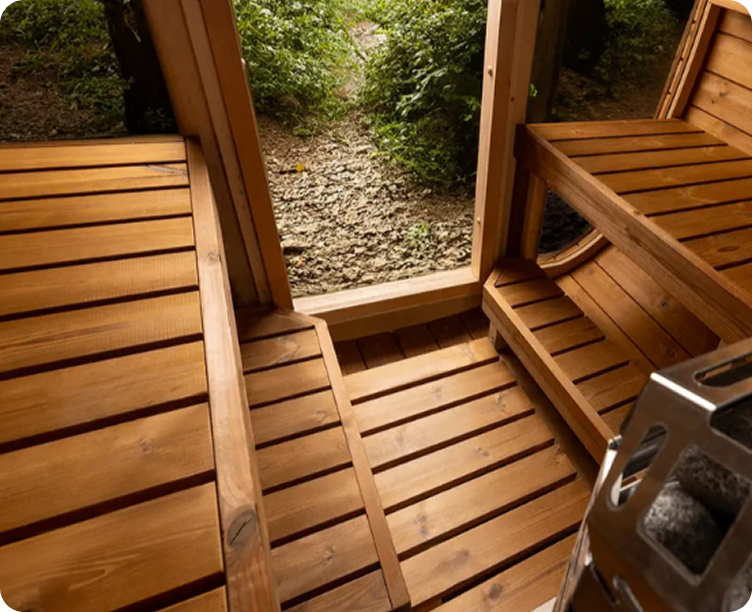
Benches deserve separate scrutiny. Knot-free boards with rounded edges are preferable because bare skin concentrates pressure and quickly reveals rough milling. Spruce knots can feel hotter than surrounding earlywood and may contain resin. Cedar is pitch-free, but knots and splinters are still possible in character grades. A sauna can sensibly use spruce for walls and a different low-density species for benches, or cedar paneling with carefully selected cedar or alternative bench stock.
Resin Knots and Surface Quality
Spruce contains resin, and heat can occasionally draw it from pockets or knots. High-quality sauna stock is selected and dried to control this behavior, but it cannot always eliminate it. A small hardened bead is primarily a maintenance issue; active resin on a backrest or bench can be uncomfortable and may stain fabric. Manufacturers may recommend allowing it to harden before gently removing it without gouging the wood.
Cedar is commonly described as free of pitch and resin, which is a meaningful advantage in a hot interior. That does not make cedar maintenance-free. Soft surfaces can dent, high-contact areas can darken, and rough grain may develop if aggressive cleaning raises the fibers. Knots can loosen in either species when unsuitable grades are exposed to repeated moisture cycling.
The best comparison is therefore selected sauna-grade spruce versus a clearly identified cedar grade, not construction lumber versus showroom cedar. Examine whether contact surfaces are clear, smooth, and free of open defects. Look for concealed stainless fasteners, eased edges, replaceable bench slats, and instructions for handling resin or raised grain. These details reveal more about user comfort than a broad species preference.
Dimensional Stability
Wood exchanges moisture with the surrounding air. As moisture content changes, boards swell or shrink, primarily across the grain. A sauna accelerates this cycle by combining steam and perspiration with high heat and rapid drying. Outdoors, seasonal humidity, rain, freezing temperatures, and sunlight add another cycle. Excess movement can open panel joints, change door fit, loosen trim, and alter barrel-band tension.
Western red cedar has an inherent advantage because of its low shrinkage factor and low density. Real Cedar technical guidance describes it as one of the most dimensionally stable softwoods. Properly dried western red cedar therefore tends to move relatively little as humidity changes, although grain orientation, board width, sapwood content, and installation still matter.
Well-prepared spruce can remain stable in sauna heat, and its long use in Nordic hot rooms proves its suitability. However, untreated spruce generally requires more reliance on correct drying, board selection, narrow profiles, expansion allowance, and a protected assembly. The difference is not an assurance that cedar never cups or spruce always moves. It means cedar offers a more forgiving natural baseline when comparable grades face repeated moisture variation.
Durability Means More Than One Thing
The word durability can describe decay resistance, resistance to dents, structural strength, finish life, or the service life of a complete building. These are different properties. A naturally decay-resistant wood may still weather, check, stain, or suffer from trapped water. A less naturally durable species may last for decades when it stays dry behind a ventilated rain screen and beneath a sound roof.
Western red cedar heartwood contains natural extractives that provide useful resistance to decay organisms and insects. This makes it a credible material for siding, trim, and other above-ground outdoor components. It is also a soft wood, so impact resistance is not its defining strength. Protect exposed lower walls from tools, furniture, sprinklers, and foot traffic even when biological durability is good.
Untreated spruce is not normally chosen for exposed exterior service on the basis of natural decay resistance alone. Its outdoor success depends more heavily on keeping water out, allowing rapid drainage and drying, and maintaining coatings or cladding systems where specified. Thermally modified spruce, pressure-treated structural components, and painted spruce are separate systems with different properties. A listing should state which one it uses.
Indoor Sauna Performance
Inside a properly built sauna, moisture exposure is intense but usually brief. Water is thrown on stones, humid air rises, occupants perspire, and surfaces then dry through heat and ventilation. This cycle favors wood that is comfortable, accurately milled, and able to release moisture. Both spruce and cedar qualify when the room is designed to dry after use.
Spruce is especially persuasive for homeowners who want a pale traditional interior and do not need a strong fragrance. It works well as paneling in an insulated assembly, and its availability can make replacement or expansion practical in regions where Nordic products are common. Cedar is persuasive when the sensory character, natural color variation, and pitch-free surface justify the price.
Interior choice should also account for cleaning habits. Neither material should be sealed with a film-forming household varnish on benches unless the sauna manufacturer explicitly approves it. A finish that becomes hot, peels, or traps moisture can undermine the wood's advantages. Follow the cabin manual for bench oil, paraffin oil, wall treatment, cure time, and heater operation after application.
Outdoor Sauna Applications
An outdoor sauna is not simply an indoor cabin placed in the yard. It must manage bulk rain, splashback, ultraviolet radiation, snow, wind, insects, foundation moisture, and seasonal movement while also handling hot-room humidity from within. The exterior assembly and interior lining have different jobs, so using different materials can be technically rational.
Western red cedar can serve as exterior cladding because its heartwood has natural durability and its dimensional stability supports siding performance. It still needs correct flashing, roof overhangs, end-grain treatment, ventilated cavities where appropriate, compatible fasteners, and separation from soil. Unfinished cedar will weather rather than retain its initial red-brown color.
Spruce is strongest outdoors when weather exposure is controlled. A substantial roof, gutters or directed runoff, raised foundation, back-ventilated coated cladding, protected end grain, and regular inspection reduce risk. Solid-spruce cabins can work in cold climates, but manufacturer approval for exterior use matters. An indoor-rated spruce cabin under a makeshift cover is not automatically an outdoor sauna.
Weather Resistance and Climate
Climate changes which weakness matters most. In a wet coastal region, slow drying, wind-driven rain, salt exposure, and biological growth demand excellent drainage and ventilation. In a hot sunny region, ultraviolet exposure, surface temperature, and rapid moisture gradients can drive fading and checking. In a freezing climate, water trapped in joints can expand, while snow loads and roof details become central.
Cedar's natural durability provides useful insurance in wet above-ground exposure, but it does not tolerate standing water indefinitely. Persistent wetting can discolor boards, corrode incompatible hardware, and eventually overwhelm natural resistance. Spruce requires a more deliberate weather barrier and finish strategy, but keeping it consistently dry can matter more than selecting a naturally durable species and then neglecting drainage.
Orientation also changes performance. A south- or west-facing wall may fade quickly, while a shaded north-facing base may remain damp. Sprinklers and roof drip lines can create severe local exposure that a climate map will not show. Before buying, observe the proposed site after rain and during the hottest part of the day. Material choice should follow the actual microclimate.
Color Change and Outdoor Weathering
Untreated wood changes color outdoors because ultraviolet light and moisture alter the surface. Spruce often transitions from pale yellow to gray, with dark spotting possible where moisture lingers. Cedar loses its saturated red-brown tones and also becomes silver-gray. The change is primarily at the surface, but uneven exposure can create stripes beneath eaves, around hardware, or behind landscaping.
Some owners welcome this patina and choose not to preserve the original color. That can be a reasonable aesthetic plan when the assembly is designed to dry and the manufacturer permits natural weathering. It is not a zero-maintenance promise. Gray wood still needs inspection for dirt, algae, failed joints, loose fasteners, and water pathways.
Owners who want stable color need a compatible exterior finish with ultraviolet protection. Transparent clear products often provide less UV protection than pigmented finishes, while opaque systems change the natural appearance more substantially. Test the product on spare material, follow surface-preparation instructions, and treat end grain where required. Mixing brands or applying finish over damp wood can reduce adhesion and produce uneven color.
Maintenance Requirements
Routine sauna care begins with drying. Use towels on benches, remove excess water, open vents and the door when appropriate, and allow residual heat to drive moisture out. Sweep or vacuum debris once surfaces are cool. Clean with the mild method approved by the manufacturer; strong chlorine products, pressure washing, abrasive pads, and household furniture polish can damage fibers or leave residues.
Spruce owners should monitor resin, knots, lower-wall staining, and any exterior coating. Resin can often be allowed to harden before careful removal. Exterior spruce should be inspected at least seasonally and after severe weather for finish failure, open end grain, or moisture accumulation. Local touch-ups performed early are easier than stripping an entire wall after widespread peeling.
Cedar owners should expect aroma to soften, interior contact areas to darken, and exterior color to change unless protected. Clean gently because the wood is soft. If the goal is to preserve the original exterior tone, plan on periodic washing and refinishing at an interval determined by exposure and the selected product rather than a universal calendar. Keep documentation so future coatings remain compatible.
Cleaning and Refinishing
A sauna's clean appearance depends more on habits than species. Bench towels limit oils and perspiration. Quick drying limits microbial growth. A soft brush or nonabrasive sponge handles most routine soil. Before applying any cleaner broadly, test it in an inconspicuous place because spruce and cedar can react differently and because stains may penetrate unevenly around knots and grain transitions.
Light sanding can refresh a worn interior surface when the manufacturer permits it. Sand with the grain, remove dust thoroughly, and avoid reducing thin paneling or rounding joints. Cedar dust and spruce dust should not be inhaled; use suitable respiratory and eye protection and keep dust away from heater elements and controls. Do not sand active mold without first correcting the moisture source.
Refinishing an exterior is a system decision. Identify the existing coating, assess adhesion, follow the finish maker's preparation requirements, and allow correct drying time. Adding a different product over an unknown coating can create peeling or blotching. When a sauna arrives unfinished, decide on the color strategy before installation so hidden edges, end grain, and low walls can receive any required treatment.
Availability and Supply Quality
Spruce is widely available in Europe and in sauna kits influenced by Nordic construction. That availability can support competitive pricing and easier procurement of profiles, but replacement boards must still match thickness, tongue-and-groove geometry, moisture content, and appearance. Generic local spruce paneling may not fit a factory-milled cabin or meet the same drying and grading standard.
Western red cedar availability varies by region and grade. Clear vertical-grain material can be expensive and may have long lead times, while knotty or mixed-grain products are easier to obtain. Buyers should be skeptical of unusually low prices attached to vague cedar claims. Confirm whether the quoted material is solid wood, veneer, laminated stock, cedar-faced panels, or a limited set of cedar components.
Supply quality affects future ownership. Ask whether the manufacturer stocks replacement bench slats, wall profiles, trim, and door parts. Record the species, grade, finish brand, color code, and batch information at installation. A slightly higher purchase price can be justified when documentation and replacement support reduce the risk of a visible mismatch years later.
Cost and Long-Term Value
Spruce generally offers the lower entry price, which can allow a buyer to allocate more budget to insulation, roofing, foundation, heater controls, glazing, and professional electrical work. Those investments often improve the ownership experience more than upgrading every concealed or protected surface to cedar. A well-designed spruce interior is not a compromise when its appearance and scent fit the buyer's preferences.
Cedar's premium reflects material cost, yield, grade, color selection, and market availability. The upgrade is easiest to justify when the buyer values the aroma and visual character every session or when the exterior benefits from natural durability. It is harder to justify when a product uses only a thin cedar accent yet prices the entire sauna as though it were a full clear-cedar structure.
Long-term value includes maintenance time, replacement availability, resale appeal, and the likelihood that the owner will use the sauna. A beautiful material that discourages use because it feels too precious is poor value. Conversely, an aromatic cedar room that turns a weekly routine into a daily one may deliver value beyond its measurable service life.
Sustainability and Material Efficiency
Environmental claims should consider source, forestry practices, transport, manufacturing yield, treatment, service life, and end-of-life options rather than assuming that one species is automatically sustainable. Request credible chain-of-custody information when it matters to the purchase. Regional sourcing may reduce transport, but durability and repairability can outweigh distance over a long service life.
Spruce's broad availability and efficient use in engineered panels or accurately milled profiles can support material efficiency. Cedar's natural durability can reduce reliance on preservative treatments in appropriate above-ground applications. Neither advantage excuses poor design. A sauna that fails early because water reaches end grain wastes more material and energy than one built from a thoughtfully specified mixed system.
Component-specific selection can reduce premium wood consumption. Cedar may be reserved for interior lining, backrests, or exposed cladding where its properties and sensory value are meaningful, while spruce or another suitable wood serves protected framing. Repairable assemblies, replaceable bench slats, mechanical fasteners, and accessible roof details can extend service life regardless of species.
Construction Quality Matters More Than the Label
A durable sauna begins below the walls. The foundation must be level, stable, and capable of keeping wood away from soil and standing water. Drainage should direct rain and wash water away from the base. Roof edges should prevent concentrated runoff on wall joints. Flashing, membranes, and penetrations must be detailed for the specific design rather than added as an afterthought.
Inside, wall and ceiling assemblies must manage heat and vapor according to the sauna's construction method. An insulated framed cabin behaves differently from a solid log or stave structure. Ventilation openings must suit the heater and layout. Glass increases calculated heater load and changes condensation patterns. These factors influence drying and joint movement more strongly than a small difference between two suitable interior woods.
Hardware completes the system. Stainless or otherwise manufacturer-approved fasteners reduce corrosion and staining, particularly with cedar extractives and outdoor moisture. Hidden fasteners protect skin from hot metal. Door hinges, bands, trim, and roof attachments need adjustment access. Ask for an installation manual before buying; vague assembly imagery is not a substitute for water-management details.
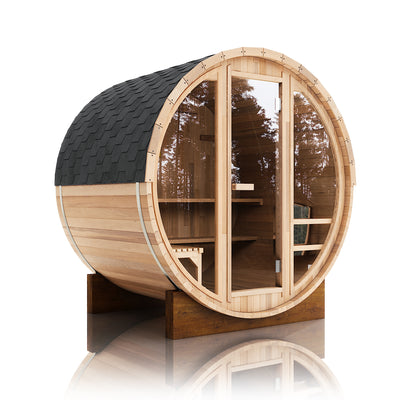
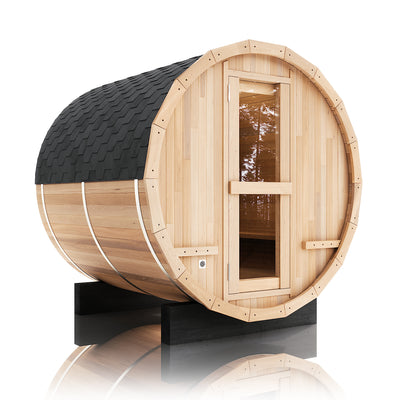
Barrel Saunas and Wood Movement
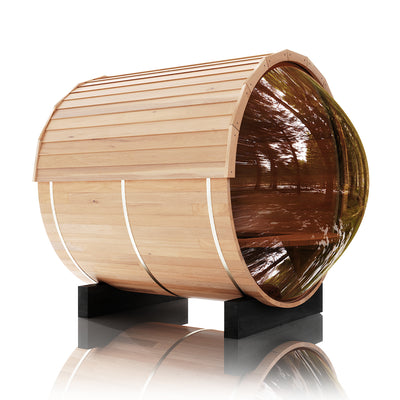
Barrel saunas rely on shaped staves held together by bands, so wood movement is visible in band tension and joint tightness. Spruce can be used successfully, particularly when it is properly dried and the barrel has a protective roof system. Owners should expect to inspect bands and follow seasonal adjustment instructions rather than assuming the shell will remain unchanged.
Cedar's dimensional stability and natural durability make it attractive for barrel construction, but a cedar barrel is not automatically watertight or maintenance-free. End walls, lower staves, door frames, and roof-facing joints remain vulnerable. A rain jacket, shingles, or another approved roof can be more important than the species when the barrel sits in sustained precipitation.
Interior ergonomics also matter. Curved walls reduce usable shoulder room near the sides, and benches may place occupants closer to knots or hardware. Inspect the grade of contact surfaces and the finish of stave edges. If the product mixes cedar staves with another species for benches or end walls, evaluate each component instead of treating the barrel as one homogeneous material.
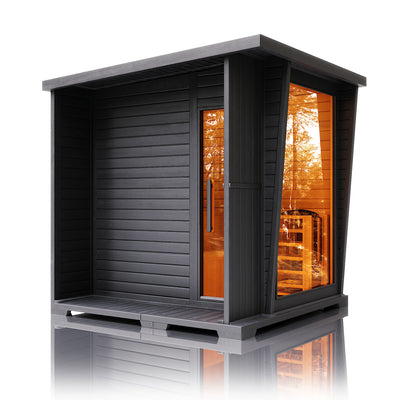
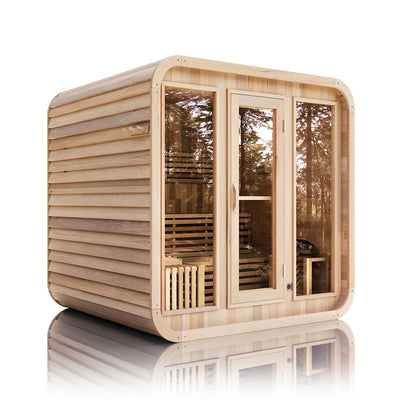
Cabin Cube and Pod Saunas
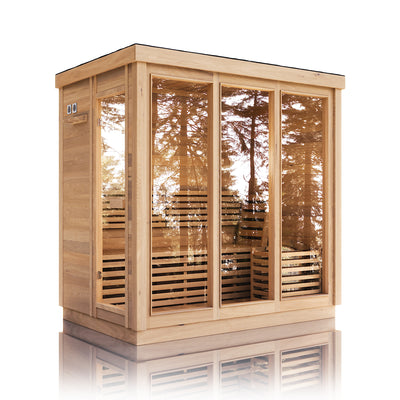
Rectangular cabins make it easier to separate structure, insulation, interior lining, and exterior cladding. This favors a mixed-material strategy. Spruce can create a bright interior while a ventilated exterior cladding handles rain, or cedar can provide the exposed facade and aromatic lining while structural framing remains another species.
Cube and pod designs often use large glass areas. Glass does not insulate like a well-built opaque wall, so heater sizing and cold-climate performance need attention. Condensation can collect around sills and lower frames. Cedar's natural durability is useful but does not replace sill pans, drainage paths, compatible sealants, and inspection access. Spruce near glazing needs equally careful protection.
Flat or low-slope roofs demand particular scrutiny. Confirm the membrane, slope, edge flashing, drainage, snow-load rating, and warranty. A premium cedar wall beneath a poorly drained roof is a weak purchase. A modest spruce cabin with a proven roof and raised foundation may provide the more durable ownership experience.
When Spruce Is the Better Choice
Choose spruce when the desired interior is light, understated, and authentically Nordic. It suits buyers who prefer a mild natural scent, appreciate visible knots or pale clear grain, and would rather invest in the heater, insulation, roof, or seating layout than pay for cedar throughout. It is particularly compelling for indoor cabins and protected outdoor structures.
Spruce also makes sense where manufacturer expertise and regional supply are strong. A proven sauna system built around properly dried spruce can be easier to service than an imported cedar product with no matching parts. Product-specific engineering, installation instructions, and a useful warranty are more valuable than changing species without understanding the assembly.
The buyer must accept the material's ownership expectations. Resin may occasionally appear, light surfaces can show stains, exterior exposure needs disciplined protection, and knots influence both appearance and touch comfort. These are manageable characteristics when understood before purchase. They become disappointments when a seller presents spruce as visually uniform or maintenance-free.
When Cedar Is the Better Choice
Choose western red cedar when fragrance and warm color are central to the sauna experience. It suits buyers who want the material itself to provide a premium sensory identity rather than functioning as a neutral background. Clear or carefully selected cedar is especially appealing for backrests, interior paneling, and other visible surfaces that are appreciated at close range.
Cedar is also the more forgiving untreated choice for certain above-ground exterior components because of natural heartwood durability and dimensional stability. That advantage is meaningful in humid or rainy settings, but only when the product identifies the species and grade and keeps wood out of standing water. A roof, foundation, and drying path remain non-negotiable.
The buyer should accept cedar's natural variation, soft surface, color change, and premium price. Aroma can fade, sunlight can gray the exterior, and clear stock can be expensive to replace. Cedar is worth the upgrade when those characteristics are part of the desired experience, not merely because the word appears in a product title.
Mixed Wood Sauna Designs
The most technically efficient sauna may use both materials. Spruce can serve as protected framing or light interior paneling, while cedar is placed on exterior cladding, backrests, trim, or selected contact surfaces. Another low-density species may be used for benches. This approach assigns material cost to the locations where each property creates value.
Mixed construction is not evidence of inferior quality. It becomes a problem only when documentation is vague or when adjacent woods are detailed incompatibly. Different movement, color change, finish absorption, and extractives need to be considered. A component schedule should identify species, grade, coating, fasteners, and replacement method for each visible area.
Rodeo Wellness shoppers should verify the exact material specification for the model under consideration rather than assuming a site-wide standard. Ask whether cedar describes the complete shell, the interior, benches, exterior accents, or an optional upgrade. That question allows a fair comparison with a spruce model and prevents paying a full-material premium for limited coverage.
How to Compare Product Listings
Start with the complete bill of materials. Record the species and grade for exterior walls, interior panels, frame, benches, floor, roof structure, door frame, and trim. Note whether boards are solid, laminated, finger-jointed, veneered, thermally modified, painted, or factory finished. Words such as premium, Canadian, Nordic, or select need a defined standard behind them.
Then compare construction: overall wall thickness, insulation, vapor control, roof system, glass area, drainage, base detail, ventilation, hardware, and heater sizing. Request drawings and the installation manual. Confirm whether the warranty covers checking, warping, finish failure, water ingress, resin, and normal weathering, because many wood changes are classified as expected rather than defects.
Finally, compare ownership requirements. Ask what must be done before first use, how often exterior coatings need inspection, which cleaners are approved, how the sauna should dry, whether replacement boards are stocked, and who performs warranty service. The best listing makes these responsibilities clear before payment.
Common Buying Mistakes
The first mistake is comparing species names without comparing grades. Clear cedar and knotty spruce do not represent the only options, and premium Nordic spruce may be more carefully prepared than vague low-cost cedar. The second mistake is assuming that an aromatic or naturally durable wood can compensate for a weak roof or wet base.
Another mistake is choosing by the day-one color. Both woods change inside and outdoors, and preserving exterior color requires maintenance. Buyers also overlook component coverage, paying for a cedar label when only a few surfaces use cedar. Others reject spruce because of resin without checking whether contact areas use a different species or sauna-grade selection.
The final mistake is applying generic deck or furniture products inside the hot room. Heat changes exposure conditions, and some finishes can become unpleasant, slippery, or difficult to repair. Use only products and procedures approved for the exact sauna surface. When instructions conflict, obtain written clarification from the sauna and finish manufacturers.
Frequently Asked Questions
Is Spruce or Cedar Better for a Sauna
Both are suitable. Spruce is an excellent value for a light traditional interior, while western red cedar adds stronger aroma, richer color, natural durability, and exceptional softwood stability. For an exposed outdoor shell, cedar usually has the more forgiving natural properties. For a protected indoor room, design, grade, and workmanship often matter more than the species.
Does Spruce Get Too Hot in a Sauna
Proper sauna-grade spruce is a low-density softwood commonly used in hot rooms and should remain comfortable as wall paneling. Bench comfort depends on surface selection, knots, edges, heater distance, and exposed hardware. Test surfaces cautiously during commissioning and follow heater clearances and operating limits.
Does Cedar Get Too Hot in a Sauna
Western red cedar has low thermal conductivity and is widely used for sauna interiors. It generally remains comfortable, but knots, metal fasteners, and surfaces close to a heater can feel hotter. Correct layout and smooth clear contact stock remain important.
Does Spruce Leak Resin
Spruce can release resin from knots or pockets when heated. Sauna-grade selection and drying reduce the risk but may not eliminate it. Follow the manufacturer's method for allowing resin to harden and removing it carefully. Avoid placing resinous knots on benches or backrests when possible.
Does Cedar Have Resin
Western red cedar is valued in sauna use partly because it is free from pitch and resin. It still contains natural extractives responsible for its color, scent, and durability, and these can interact with moisture, metals, or finishes. Use compatible fasteners and care products.
Which Wood Smells Better
That is personal. Cedar has the stronger, more recognizable aroma; spruce has a milder fresh softwood scent. Buyers sensitive to fragrance may prefer spruce or another neutral species. Smell a warmed sample rather than relying on a cold board.
Which Wood Is More Durable Outdoors
Western red cedar heartwood generally offers greater natural decay resistance than untreated spruce. Spruce can still perform outdoors in a weather-managed, properly coated, ventilated assembly. Foundation, roof, drainage, end-grain protection, and maintenance may have a larger effect on service life than species alone.
Can a Spruce Sauna Be Used Outdoors
Yes, when the manufacturer rates the complete sauna for outdoor use and provides an appropriate roof, base, finish, and installation method. Do not assume an indoor solid-spruce cabin becomes outdoor-rated simply because it is placed under a small cover.
Can Cedar Be Left Unfinished Outdoors
Cedar can be allowed to weather when the manufacturer permits it and the assembly drains and dries. It will not retain its original red-brown tone; ultraviolet exposure typically shifts it toward gray. Uneven exposure can create uneven color.
Can Spruce Be Left Unfinished Outdoors
Unfinished spruce has less natural decay resistance and generally benefits from stronger weather protection. Follow the product's exterior coating and maintenance requirements. A broad roof helps but does not protect low walls, splash zones, wind-driven rain, or exposed end grain completely.
Which Wood Requires Less Maintenance
Inside, both mainly need gentle cleaning and reliable drying. Cedar avoids spruce's resin issue and has useful dimensional stability. Outdoors, cedar may be more forgiving biologically, but maintaining its original color still requires finishing. Spruce often demands more disciplined coating and moisture management.
Which Wood Is More Expensive
Western red cedar is usually more expensive than spruce, especially in clear vertical-grain grades. Regional supply and the amount of cedar used can change the difference. Compare component coverage and grade rather than price per complete sauna alone.
Is Knotty Spruce Bad for a Sauna
No. Knots create a traditional appearance and can be acceptable on walls and ceilings when they are sound and properly milled. Contact surfaces benefit from clearer stock because knots can feel hotter, release resin, or loosen. Grade should match the component.
Is Knotty Cedar Good Outdoors
Knotty western red cedar can be a practical and attractive exterior cladding when the grade, fasteners, profile, and weather detailing are appropriate. Natural durability varies with heartwood content, and knots can influence movement and checking. Review the actual grade standard.
Which Is Better for a Barrel Sauna
Cedar offers useful dimensional stability and natural durability, while properly dried spruce provides traditional character and value. Barrel roof protection, stave machining, moisture content, band adjustment, and lower-stave drainage usually matter more than the simple species choice.
Which Is Better for Sauna Benches
Clear, smooth, low-density stock is the priority. Cedar can make comfortable aromatic benches and is pitch-free. Spruce can work when knots and resin are carefully controlled, although many manufacturers pair spruce walls with aspen, alder, linden, or another dedicated bench wood.
Does Cedar Aroma Last Forever
No. Cedar's fragrance generally becomes less intense with time, ventilation, oxidation, and surface buildup. Gentle cleaning or light manufacturer-approved sanding may refresh exposed wood, but buyers should not treat permanent strong aroma as a guaranteed performance feature.
Is Thermally Modified Spruce the Same as Regular Spruce
No. Thermal modification changes moisture behavior, color, resin, biological durability, and some mechanical properties. Genuine ThermoWood also follows defined process classes. Compare thermally modified spruce as a documented product rather than applying untreated-spruce assumptions.
How Long Will a Spruce or Cedar Sauna Last
No responsible universal lifespan can be assigned from species alone. Service life depends on grade, construction, roof, foundation, exposure, ventilation, heater operation, cleaning, coating, inspection, and repair. A documented system with replaceable components is the safer purchase.
How Can I Verify the Wood Before Buying
Request the species, grade, component schedule, finish specification, installation manual, and warranty exclusions in writing. Ask for close photographs of current production rather than only staged images. Confirm that replacement profiles and matching finish information will remain available.
Editorial Review and Primary Sources
This article was reviewed against current technical and manufacturer information on September 15, 2026. Species, grades, product configurations, finishes, and care guidance can change. Verify the exact sauna specification and installation manual before publication or purchase.
Harvia guidance on sauna bench woods and outdoor spruce
Harvia Nordic spruce material description
Western Red Cedar raw material technical guide
Western Red Cedar paneling and sauna technical guide
International ThermoWood Association material overview
Internal Linking Note
Link this page to cedar versus hemlock, Thermowood versus cedar, outdoor sauna maintenance, barrel versus cube design, heater sizing, foundations, and capacity guides. Keep this page centered on untreated spruce and western red cedar so it supports rather than competes with the thermally modified wood comparison.
Final Thoughts
The spruce vs cedar sauna comparison is ultimately a choice between two legitimate sauna traditions with different strengths. Spruce creates a bright, calm room with mild scent, accessible pricing, and proven use in Nordic cabins. Western red cedar creates a warmer, more aromatic room with natural heartwood durability, low thermal conductivity, and excellent dimensional stability.
For interiors, comfort depends on grade, surface quality, bench selection, fasteners, ventilation, and cleaning more than a simple winner label. For outdoor saunas, cedar provides a more forgiving natural starting point, while spruce needs a stronger weather-management and finish strategy. In either case, roof, drainage, foundation, end-grain protection, and drying determine whether the material reaches its potential.
Buy the documented assembly rather than the species headline. Verify every component, decide whether natural color change is acceptable, understand maintenance before installation, and prioritize a manufacturer that supplies clear manuals and replacement parts. A carefully built spruce sauna is better than a poorly detailed cedar one, and a mixed-material design can outperform either one-species approach.
Our Recommendation
For most indoor buyers and protected installations, we recommend choosing by experience and build quality: spruce for a light Nordic aesthetic, mild scent, and strong value; western red cedar for a richer aromatic environment and premium visual character. Spend first on correct heater sizing, ventilation, benches, insulation, and reliable installation, then upgrade the species where it meaningfully improves daily use.
For exposed outdoor use, western red cedar wins the direct comparison when the product uses documented heartwood-rich material and sound weather detailing. Its natural durability and dimensional stability provide valuable margin. Spruce remains a sensible choice when the complete sauna is explicitly outdoor-rated and uses a proven roof, raised foundation, ventilated cladding or coating system, compatible hardware, and a realistic inspection schedule.
Our preferred approach is component-specific. Use cedar where aroma, touch, appearance, or exterior durability justify it; use high-quality spruce where protection and traditional character make it effective; and consider another clear low-density species for benches when appropriate. Rodeo Wellness buyers should confirm the exact model's material schedule and treat cedar coverage, grade, roofing, and foundation design as separate value questions.



 OUR BEST SELLERS