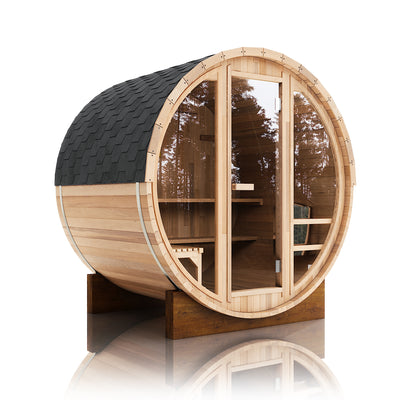
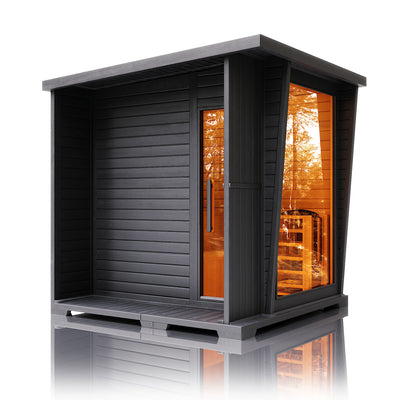
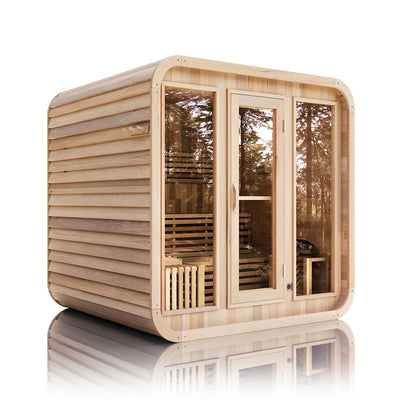
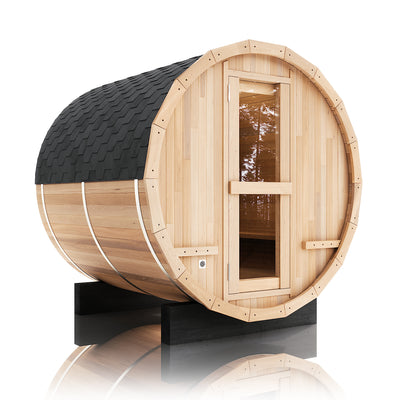
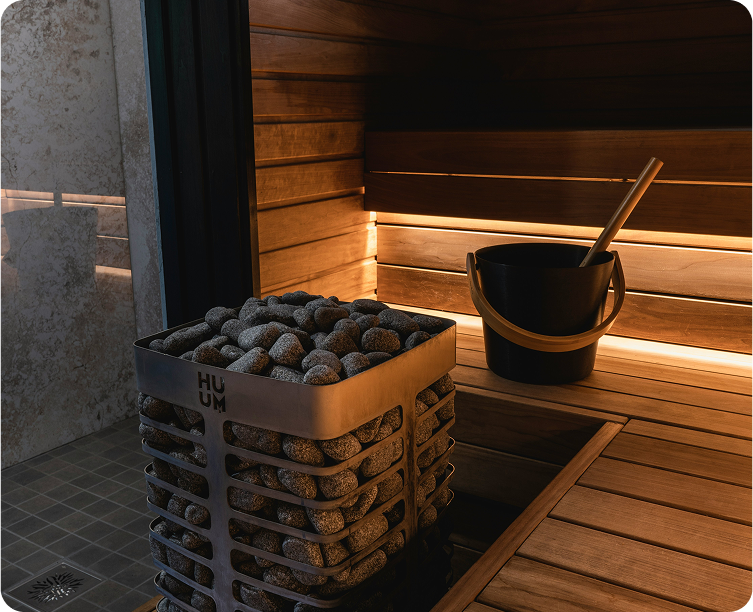
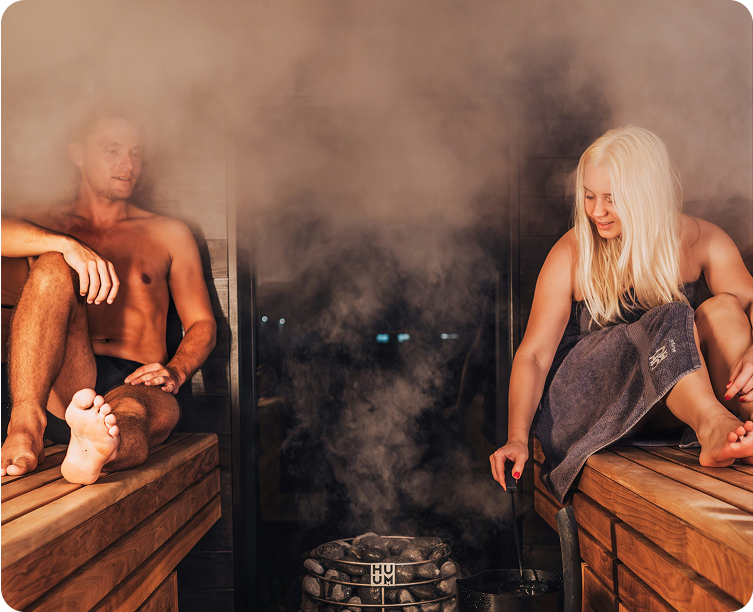
The thermowood vs cedar sauna decision is a comparison between modified performance and natural character. Thermally modified wood is valued for reduced moisture movement, improved dimensional stability, consistent dark color, and resistance to biological degradation. Western red cedar is valued for natural durability, low density, strong dimensional stability, distinctive grain, and the aroma many buyers associate with a premium sauna.
Neither material guarantees a durable outdoor sauna by itself. Roof design, end-grain protection, drainage, base clearance, ventilation, fastening, glazing, assembly, exposure, and maintenance can outweigh the species name. A well-built cedar sauna on a dry foundation can outlast a poorly detailed Thermowood structure, while stable thermally modified boards cannot compensate for standing water or a failing roof.
This guide compares durability, movement, weather resistance, aroma, color, maintenance, appearance, handling, comfort, and realistic ownership expectations. It also explains why ThermoWood is a controlled trademark rather than a generic synonym for every heat-treated board, and why cedar buyers should verify species, grade, heartwood, and where the named material is actually used.
Quick Verdict
Choose Thermowood when dimensional stability, a uniform contemporary brown appearance, resin-free material, and predictable behavior through changing humidity are the main priorities. Choose western red cedar when aroma, naturally varied red-brown color, light weight, finish acceptance, and traditional North American sauna character matter more.
For exposed outdoor shells, genuine durability-grade ThermoWood can offer the stronger technical starting point, particularly where repeated moisture cycling is expected. For the interior and benches, western red cedar remains the more sensory premium choice for buyers who enjoy its fragrance and visual variation. A mixed-material system can be ideal when each component is selected for its actual job.
|
Decision Factor
|
Thermowood
|
Western Red Cedar
|
| Dimensional stability |
Thermal modification reduces moisture movement |
Naturally low shrinkage and strong softwood stability |
| Weather strategy |
Thermo-D is intended for demanding above-ground exterior uses |
Naturally durable heartwood; detailing and drying remain essential |
| Aroma |
Subdued heat-treated wood scent |
Distinctive cedar fragrance, strongest when new and warm |
| Color |
More uniform dark brown through the section |
Varied amber, red, brown, and lighter tones |
| UV weathering |
Unfinished surfaces gray outdoors |
Unfinished surfaces also gray, often unevenly by exposure |
| Best buyer |
Prioritizes stability and modern consistency |
Prioritizes sensory character and natural variation |
How We Evaluated Outdoor Sauna Woods
This is a research-based commercial guide prepared for Rodeo Wellness readers. It does not claim laboratory testing of each sauna or lumber shipment. The analysis uses current International ThermoWood Association guidance, Western Red Cedar Lumber Association resources, manufacturer care information, and practical outdoor-sauna construction considerations.
We weighted moisture behavior, dimensional stability, biological durability, weather exposure, surface checking, color change, aroma, heat comfort, finish expectations, fastening, maintenance, sourcing clarity, and complete construction quality. Wood is variable, so grade, cut, growth conditions, machining, storage, moisture content, and component thickness can change performance within either category.
Rodeo Wellness sells saunas using western red cedar, hemlock, and other model-specific wood systems. Readers should consider that commercial relationship. The recommendation favors cedar where its distinctive experience is meaningful, but it does not claim that cedar is technically superior in every exposed component or climate.
What Thermowood Means
Thermally modified timber is wood changed by a controlled high-temperature process that alters its moisture behavior and other properties. The process commonly uses heat and steam rather than added wood preservatives. It can be applied to species such as pine, spruce, and other approved raw materials, so Thermowood does not identify a single tree species.
ThermoWood is a registered trademark owned by the International ThermoWood Association. The association states that genuine ThermoWood follows defined production criteria and audited quality control. Buyers should distinguish this from generic heat-treated, kiln-dried, carbonized, or thermally modified marketing terms that may describe different processes and performance.
The association identifies Thermo-S and Thermo-D classes. Thermo-S emphasizes stability and is used for interiors and limited exterior exposure. Thermo-D emphasizes durability and weather resistance for more demanding outdoor applications such as cladding and decking. An outdoor sauna listing should identify the treatment class or provide equivalent technical documentation.
What Cedar Means
Cedar is also not one uniform material. Outdoor sauna listings may refer to western red cedar, Canadian red cedar, aromatic cedar, white cedar, or simply cedar. These names can cover different species, grades, colors, densities, and resistance. Buyers should request the botanical or recognized commercial species and the component schedule.
Western red cedar is the premium reference in this guide because it is widely used for sauna cladding and outdoor structures. Industry resources describe it as naturally resistant to moisture, decay, and insects, dimensionally stable, low in density, free from pitch and resin, and receptive to finishes. The heartwood carries much of the natural durability; sapwood and low grades may perform differently.
A product may use cedar only for benches or interior lining while using hemlock, spruce, or another material outside. It may use cedar accents rather than a full cedar shell. Read the specification by component: exterior walls, interior cladding, structural frame, roof, floor, benches, door frame, and trim.
Durability
Durability has several meanings. Biological durability describes resistance to decay organisms. Service life describes how long the complete assembly performs in a particular exposure. Surface durability concerns dents, checking, erosion, and wear. A wood can rate well biologically and still look weathered or fail early through poor detailing.
Thermal modification reduces the wood's equilibrium moisture content and changes the nutrients and structure available to decay organisms. The International ThermoWood Association positions Thermo-D for above-ground exterior exposure and notes improved resistance to biological degradation. It does not recommend ThermoWood for direct soil or water contact.
Western red cedar heartwood has natural extractives associated with decay and insect resistance. Western wood industry guidance has long used it for siding, decks, garden structures, doors, windows, and sauna paneling. Its natural durability is an advantage, but lower wet walls, end grain, sapwood, and persistently shaded areas still need careful drying.
The practical result is close: both are credible outdoor-sauna materials when specified properly. Thermowood offers engineered consistency in moisture behavior; cedar offers natural durability with proven exterior use. Construction quality and exposure decide more than a broad winner label.
Dimensional Stability
Outdoor saunas cycle between sun, rain, cold, heat, humidity, and drying. Wood expands as it gains moisture and contracts as it loses it. Excess movement can open joints, affect doors, loosen fasteners, change barrel-band tension, and create uneven gaps around glass or roofing.
Thermal modification is designed to reduce moisture uptake and swelling or shrinkage. The International ThermoWood Association identifies enhanced dimensional stability as a central property. This makes Thermowood attractive for interlocking panels, cladding, doors, trim, and barrel staves exposed to repeated seasonal change.
Western red cedar is already one of the more stable softwoods because of its low density, low shrinkage, and moisture behavior. Real Cedar technical material describes it as one of the most dimensionally stable softwoods. Properly dried and installed cedar can perform very well, but individual boards and mixed grain may move differently.
Which Material Moves Less
Thermowood generally has the stronger material-level argument for reduced moisture movement because modification intentionally lowers equilibrium moisture content. Cedar remains naturally stable and may be entirely sufficient. The exact board, treatment, moisture at assembly, fastener design, and joint system determine whether the theoretical advantage appears in the sauna.
Weather Resistance
Weather resistance is not the same as waterproof. Both materials absorb some surface moisture and experience UV radiation, dirt, biological growth, and erosion. The sauna needs a functioning roof or approved rain covering, drainage away from the base, protected end grain, ground clearance, and ventilation around the shell.
The ThermoWood Handbook states that untreated thermally modified material remains drier than unmodified timber but recommends surface treatment against humidity, erosion, and UV where exposed, especially in warm and humid climates. It also notes that superficial mold can occur from airborne organisms and impurities.
Western red cedar can be left unfinished and still provide a long service life in many exterior applications when design and maintenance are sound. Real Cedar cautions that natural weathering is often uneven in mixed moisture and sun exposure and that drying after wetting remains important. A finish preserves appearance more than the underlying species name does.
Aroma
Aroma is cedar's clearest experiential advantage. Western red cedar contains natural extractives that create its recognizable fragrance, particularly when the wood is new and warmed. Many buyers interpret that scent as part of the sauna ritual and are willing to accept color variation or a higher price to obtain it.
The scent changes over time. Heat, ventilation, cleaning, surface oxidation, and repeated use can reduce intensity. Sanding may temporarily expose fresher material, but it should not become a routine attempt to manufacture aroma. People with fragrance sensitivities may prefer a less aromatic species.
Thermowood develops a characteristic warm, toasted scent during modification, but it is generally less resinous and less recognizably aromatic than cedar. The process makes the material resin-free according to the association. Buyers seeking a quiet neutral interior may see this as an advantage rather than a compromise.
Color and Grain
Thermowood usually begins with a uniform brown tone created through the board, with depth depending on species and process. This supports contemporary design and can make mixed boards appear more cohesive. Because the color is not merely a thin surface stain, a fresh cut reveals similar coloration, though weathering still affects exposed surfaces.
Cedar offers broader natural variation: honey, amber, rose, reddish brown, darker heartwood, pale sapwood, straight grain, and knots depending on grade. That variety gives a sauna warmth and individuality. It can also produce a busier exterior than buyers expect from edited product photographs.
Order or inspect actual samples from the current production run. Website images change with lighting, finish, camera processing, and screen calibration. Ask whether the delivered sauna is clear-grade, knotty, mixed-color, vertical-grain, flat-grain, or another defined grade. These distinctions can affect appearance more than species alone.
How Both Materials Weather
UV radiation changes both. Untreated Thermowood loses its original brown and trends toward gray. Untreated cedar loses its red-brown color and also grays. Neither material keeps a fresh showroom tone indefinitely outdoors without a compatible maintenance plan.
Uniform weathering requires relatively uniform exposure. Roof overhangs, trees, walls, sprinklers, snow, prevailing rain, and different compass directions create uneven color. Cedar may develop dark or blotchy areas in climates with inconsistent wetting. Thermowood can also show superficial mold or uneven aging where moisture remains.
Decide at purchase whether the goal is preserved color or natural gray. If preserving color, use the sauna manufacturer's approved exterior finish and schedule. If allowing gray, accept that the transition may take time and may not be perfectly uniform. Good drainage and cleaning remain necessary in either strategy.
Maintenance
No outdoor wood sauna is maintenance-free. The interior needs drying, gentle cleaning, clear vents, stone and heater care, and inspection of benches and floors. The exterior needs roof, seal, fastener, finish, base, splashback, and drainage checks. Material choice changes the emphasis, not the existence, of care.
Thermowood is often sold as low maintenance because it moves less and resists decay better than its unmodified source species. If the owner accepts gray, exterior coating may be optional under product guidance. If the brown appearance matters, a pigmented UV-protective finish and periodic renewal are normally needed.
Cedar also performs unfinished, but maintaining the fresh red-brown color requires regular attention. Real Cedar notes that all finishes weather and require cleaning and maintenance. Cedar accepts stains well, which can make refinishing manageable when the surface was prepared and coated correctly.
|
Ownership Goal
|
Thermowood Expectation
|
Cedar Expectation
|
| Keep original color |
Use approved pigmented UV protection and renew |
Use approved penetrating finish and maintain regularly |
| Allow natural gray |
Clean and inspect; expect surface change |
Clean and inspect; expect possibly uneven gray |
| Humid climate |
Prioritize finish, airflow, roof, and drainage |
Prioritize drying, end grain, finish, and mildew control |
| Low routine effort |
Accept weathered color and maintain structure |
Accept weathered color and clean contaminants |
| Premium interior |
Subdued, uniform, resin-free character |
Aromatic, varied, traditional character |
Surface Checking, Splits, and Brittleness
Small surface checks can occur in outdoor wood as moisture and temperature change. They do not automatically mean structural failure, but their location and severity matter around fasteners, bands, doors, glass, benches, and roof details. Document changes and consult the manufacturer when a crack grows or affects function.
Thermal modification can lower some strength properties and make certain wood more brittle during machining or fastening. The International ThermoWood Association states that ThermoWood is not intended for load-bearing structures. Sauna manufacturers compensate through component design, dimensions, fastener choices, and separate structural systems.
Cedar is light and workable but relatively soft, so it can dent and crush under overdriven fasteners or rough freight handling. Knots and grain direction influence splitting. Pre-drilling, correct hardware, moisture conditioning, and following assembly torque protect both materials.
Fasteners and Hardware
Exterior sauna hardware should be specified for heat, moisture, and the wood chemistry. Stainless steel or other manufacturer-approved corrosion-resistant fasteners are common. Real Cedar warns that iron can react with cedar extractives and create blue-black staining, while rust causes reddish discoloration.
Thermowood's lower moisture movement does not eliminate corrosion or fastening requirements. Modified material may need pre-drilling and controlled torque to avoid splitting. Follow the kit manual rather than replacing supplied screws or bands with visually similar hardware.
Inspect barrel bands, hinges, door hardware, roof fasteners, and bench connections periodically. Tighten only to the instructed condition. Over-tightening can damage wood and distort assemblies, while loose hardware can allow movement and leaks.
Heat and Touch Comfort
Both materials are suitable for sauna use when the product is designed correctly. Their low thermal conductivity relative to metal helps benches and cladding remain usable in a hot room. Surface smoothness, board profile, moisture, fasteners, and bench design affect comfort more than a simple material ranking.
Thermal modification can reduce thermal conductivity and remove resin, which is useful for cladding and sauna components. The uniform brown surface creates a warm visual environment. Buyers should confirm which thermally modified species is used for benches because density and feel still vary by source wood.
Western red cedar is lightweight, relatively low density, and aromatic. It is comfortable for cladding and benches when properly finished and sanded. Softness means it may dent more readily than denser materials, but it also contributes to a gentle tactile feel.
Moisture Inside the Sauna
The interior experiences steam, sweat, cleaning water, and rapid heat cycles. It must dry between sessions. Neither cedar extractives nor thermal modification makes poor ventilation acceptable. Leave vents and the door in the approved drying state, remove standing water, and use towels to reduce soil on benches.
Avoid ordinary exterior stain or sealer inside the hot room. Products not formulated for sauna temperatures may emit odors, become sticky, or create unwanted contact surfaces. Redwood Outdoors, for example, advises exterior-only use for standard stains and sealants and recommends only sauna-specific products inside.
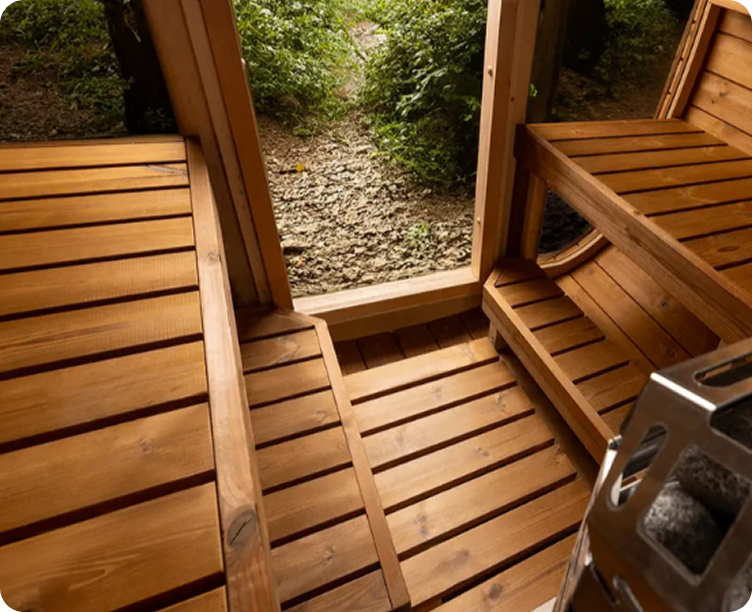
Watch lower wall edges, floor interfaces, hidden bench contact points, and areas behind heater guards. These dry more slowly than open cladding. A mixed-material interior can place the most comfortable species on benches and a stable species on wall surfaces when the design and warranty permit it.
Roofing and Foundation Matter More Than Species
Most premature outdoor-sauna problems begin with water management. A roof that leaks, a flat base that ponds water, soil contact, sprinkler spray, and blocked airflow can overwhelm the natural advantages of either material. The foundation must remain level so doors, glass, panels, and barrel staves stay aligned.
Cabins need a correctly sloped and detailed roof or membrane, protected penetrations, and controlled runoff. Barrels may use shingles, a rain jacket, or another approved cover. End walls and stave joints still need inspection. Ground-level splashback should not repeatedly wet lower boards.
Before comparing wood upgrades, price the base, drainage, roof package, gutters where appropriate, delivery, assembly, and maintenance access. Spending on these systems often produces more service-life value than choosing a premium species while leaving the structure exposed.
Climate Considerations
Wet and Humid Climates
Thermo-D has a strong technical case because reduced moisture uptake and improved biological resistance address repeated wetting. Surface treatment, airflow, roof coverage, and cleaning remain recommended. Cedar also performs well, but shaded damp areas and end grain require disciplined drying and mildew management.
Cold and Snowy Climates
Freeze-thaw cycles, snow load, drifting, meltwater, and seasonal movement affect the complete structure. Both materials can work when the foundation, roof, door, bands or panels, and drainage suit the climate. Stability may favor Thermowood; cedar remains credible with correct seasoning and joinery.
Hot and Sunny Climates
UV protection and color expectations dominate. Both woods gray without protection. Dark Thermowood may absorb noticeable solar heat, while cedar color can change unevenly. Shade and a compatible pigmented finish can protect appearance.
Coastal Climates
Salt and wind-driven moisture increase cleaning and hardware demands. Use corrosion-resistant fasteners, inspect glazing and roof seals, rinse deposits using approved methods, and maintain airflow. Material choice does not eliminate salt exposure.
Dry Climates
Low humidity and intense sun can accelerate surface drying and checking. Avoid placing the sauna where irrigation repeatedly wets one side. Cedar may weather toward a relatively even silver gray in dry exposure, while Thermowood also grays.
Appearance in Barrel and Cabin Saunas
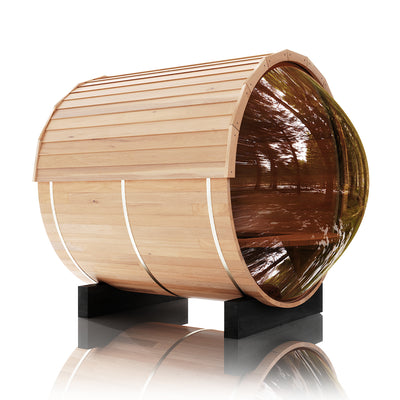
Thermowood works naturally with Scandinavian-style cabins, narrow vertical cladding, and modern barrels. Its uniform brown color creates a finished appearance without relying on wide color variation. In a barrel, reduced movement can support stave stability, though band adjustment and roofing are still required.
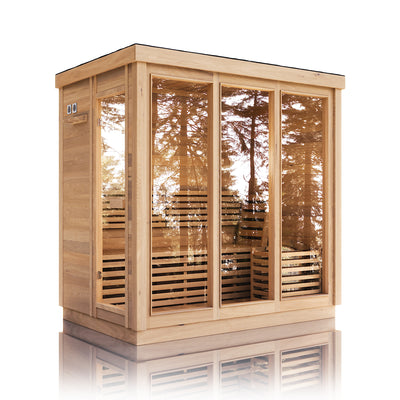
Cedar suits both traditional and modern shapes. A knotty cedar barrel feels rustic and aromatic; clear vertical-grain cedar can appear highly refined in a glass-front cabin. The same species can therefore produce very different visual results depending on grade and board selection.
Large panoramic glass reduces the visible amount of wood but increases the importance of remaining frame color and heater sizing. Dark Thermowood can create strong contrast with glass. Cedar adds warmth and grain variation. Compare actual finished-product photographs rather than isolated lumber samples.
Material Weight and Assembly
Western red cedar's low density can make components easier to handle during delivery and assembly. That is useful for long barrel staves, panels, benches, and roofs. Low weight does not reduce the need for safe lifting, staging, and a foundation designed for the complete sauna.
Thermowood weight depends on the source species and treatment, but thermal modification reduces moisture and can lower density. Boards may be more brittle at edges and fasteners, making careful handling important. Store components dry, supported, and protected before assembly.
Follow the kit sequence and acclimation guidance. Do not leave either product scattered on wet soil or exposed to rain while the base is prepared. Delivery damage, missing parts, and moisture imbalance should be addressed before forcing panels or staves together.
Sourcing and Quality Control
Genuine ThermoWood carries a specific trademark and quality system. If a seller uses the term generically, request the producer, treatment class, source species, and technical sheet. Other thermally modified products can be good, but their performance should be documented rather than assumed equivalent.
Cedar buyers should request species, grade, heartwood or sapwood content where relevant, knot level, grain, board thickness, and component coverage. Marketing terms such as premium or Canadian do not replace recognized specifications. Mixed lots can produce more color variation than samples.
For either material, ask who manufactures the sauna, where replacement boards come from, whether profiles are proprietary, and how warranty claims are handled. A durable species is more valuable when compatible parts and informed support remain available.
Sustainability Considerations
ThermoWood is made from renewable timber using heat and steam without added chemicals under the association process. Improved durability can extend service life, and the material can be reused, recycled, or used for energy at end of life according to association guidance. Source certification and shipping still matter.
Western red cedar is also renewable and available from managed forests, with environmental performance influenced by forestry, grade recovery, transport, finishing, and service life. A durable locally appropriate material can reduce replacement. Verify responsible sourcing rather than assuming every product shares the same credentials.
Maintenance choices affect lifecycle impact. Repeated coatings add materials and labor, while allowing natural gray reduces finish use but may change appearance. A long-lived, repairable sauna on a sound foundation is generally preferable to chasing a perfect material label in a disposable assembly.
Cost and Long-Term Value
Material price varies by species, grade, producer, treatment, thickness, region, and kit design. Thermowood can command a premium over ordinary spruce or pine because of processing and quality control. Clear western red cedar can also be expensive, while knotty grades may cost less and create a different appearance.
Compare whole-sauna value, not price per board. Roof, glass, heater, benches, hardware, foundation, freight, assembly, electrical work, warranty, and maintenance influence the total. A more stable shell may reduce adjustment, while cedar aroma may create greater personal value even if technical performance is similar.
Request a component-level material schedule and complete installed quote. If a seller charges for cedar, confirm whether the upgrade applies to the interior, exterior, benches, floor, or entire shell. If paying for Thermowood, confirm the source species and treatment class.
Ownership Expectations
Thermowood owners should expect the brown surface to gray without UV protection, possible superficial mold in damp exposure, and periodic roof, base, seal, and finish checks. Reduced movement is a meaningful advantage, not permission to ignore joints or drainage. The interior still needs drying and cleaning.
Cedar owners should expect fragrance to moderate, natural color variation to evolve, and exposed surfaces to gray unless maintained. Extractive or iron staining can occur when water and unsuitable metal interact. Soft surfaces may dent. These are manageable material behaviors, not automatic defects.
Both owners should expect seasonal inspection. Photograph panels, staves, doors, roof edges, and lower walls at installation and yearly thereafter. Early correction of drainage, hardware, or finish issues is easier than restoration after repeated wet seasons.
|
Expectation
|
Thermowood Owner
|
Cedar Owner
|
| First-year appearance |
Uniform brown begins responding to UV |
Natural red-brown variation begins changing |
| Aroma |
Mild heat-treated wood scent |
Noticeable cedar scent that gradually softens |
| Movement |
Reduced, but joints still need inspection |
Low for a softwood, but seasonal movement remains |
| Surface wear |
Possible checks and edge brittleness |
Possible dents, checks, and extractive staining |
| Long-term color |
Gray unless protected |
Gray unless protected, sometimes unevenly |
Which Material Is Better for Different Buyers
Buyer Prioritizing Stability
Thermowood is the stronger starting point, especially when a documented Thermo-D exterior is used. Confirm that the structural system and treatment class match the application.
Buyer Prioritizing Aroma
Western red cedar is the clear choice. Test a sample if anyone is sensitive to fragrance and understand that scent becomes less intense over time.
Buyer Wanting Uniform Modern Color
Thermowood offers a consistent deep-brown baseline. Preserve it with an approved pigmented finish or accept eventual gray weathering.
Buyer Wanting Natural Variation
Cedar provides richer board-to-board variation and traditional warmth. Select grade carefully so knots and color range match expectations.
Buyer Seeking Low Maintenance
Either can be low maintenance when natural gray is accepted. Thermowood generally reduces movement; cedar accepts refinishing well. Roof and drainage work remain equal.
Buyer in a Wet Climate
Thermo-D has a technical advantage, but a protected and ventilated cedar sauna can also perform strongly. Site design should decide before species preference.
Mixed-Material Saunas
The best answer may use both philosophies. A thermally modified exterior can prioritize stability and weather performance, while cedar benches and interior cladding provide aroma and tactile character. A separate structural frame can carry loads that appearance-grade material should not.
Mixed systems must be deliberate. Different woods move, weather, and accept finishes differently. Transitions, hidden fasteners, drainage, and replacement pieces need design. Ask whether the warranty treats the assembly as one tested product rather than a collection of upgrades.
Rodeo Wellness listings should be read model by model. The brand currently highlights western red cedar and hemlock in its range, while some products refer to Thermospruce or mixed interior and exterior systems. Confirm the precise materials on the current quote before comparing the sauna with a Thermowood competitor.
How to Compare Product Listings
Start with a component schedule. List exterior cladding or staves, interior lining, benches, frame, floor, roof decking, door, trim, and porch. Record species, treatment, grade, thickness, and finish for each. This prevents a cedar-accent sauna from being compared with a full Thermo-D shell as if they were equivalent.
Then compare construction: wall thickness, insulation, joint profile, roof system, glazing, fasteners, foundation requirements, drainage, ventilation, freight format, assembly, and warranty. Material quality cannot be separated from how boards are kept dry and connected.
Finally, compare ownership assumptions. Ask whether exterior treatment is optional or required, which products are approved, what color change is expected, how often the seller recommends inspection, and how replacement parts are ordered. Written care instructions are more reliable than vague maintenance-free claims.
-
Thermowood Proof: Identify producer, source species, Thermo-S or Thermo-D class, and technical documentation.
-
Cedar Proof: Identify species, grade, grain, knot level, heartwood coverage, and component use.
-
Weather System: Confirm roof, runoff, ground clearance, end grain, fasteners, and ventilation.
-
Finish Plan: Decide between preserved color and natural gray before exposure begins.
-
Service Plan: Verify replacement profiles, warranty, maintenance instructions, and seller support.
Common Buying Mistakes
Treating Thermowood as a Species
It is a modification category, and ThermoWood is a controlled trademark. Source species and treatment class still matter.
Assuming Every Cedar Is Western Red Cedar
Ask for the exact species and grade. Generic cedar terminology can hide significant differences in appearance and performance.
Believing Either Wood Is Weatherproof
Both need roof, drainage, drying, and inspection. Neither belongs in persistent standing water or soil contact unless specifically engineered for it.
Expecting Original Color Without Maintenance
UV grays both materials. Preserving brown or red tones requires an approved pigmented finish and renewal schedule.
Ignoring Component Coverage
A product may use premium wood only inside or on benches. Verify what the upgrade actually changes.
Applying Exterior Finish Inside
Use only sauna-approved interior products. Standard exterior coatings may be unsuitable at high temperature.
Paying for Wood Before Fixing Drainage
A reliable base and roof usually provide more durability than a premium material installed in a wet site.
Frequently Asked Questions
Is Thermowood Better Than Cedar for an Outdoor Sauna
Thermowood is generally better for reduced moisture movement and consistent modern appearance. Cedar is better for aroma, natural color variation, light weight, and traditional character. Construction quality can outweigh either advantage.
Does Thermowood Last Longer Than Cedar
A universal lifespan cannot be promised. Genuine Thermo-D and western red cedar heartwood are both credible exterior materials. Roof, drainage, exposure, grade, finish, assembly, and maintenance determine service life.
Which Material Warps Less
Thermal modification is designed to reduce swelling and shrinkage, giving Thermowood the technical edge. Western red cedar is also naturally dimensionally stable compared with many softwoods.
Which Smells Better
Western red cedar has the stronger recognizable sauna aroma. Thermowood has a milder heat-treated scent. Preference and fragrance sensitivity decide which is better.
Does Thermowood Turn Gray
Yes. Unfinished Thermowood exposed to UV loses its brown color and grays. An approved pigmented exterior finish helps preserve color.
Does Cedar Turn Gray
Yes. Unfinished cedar loses its original color. Dry climates may produce silver gray; mixed moisture and sun can create less uniform weathering.
Does Thermowood Need Sealing
Requirements depend on the product and exposure. The ThermoWood Handbook recommends surface protection against humidity, erosion, and UV for exposed uses, especially warm humid climates.
Does Cedar Need Sealing
It can weather naturally, but a compatible finish helps preserve color and adds protection. Follow the sauna manufacturer's exterior instructions.
Can I Seal the Inside of a Sauna
Only use products specifically approved for sauna interiors and the exact components. Do not apply ordinary exterior stain or sealer in the hot room.
Is Thermowood Chemical Free
The official ThermoWood process uses heat and steam without added chemicals. Other thermally modified products should be verified through their own documentation.
Is Cedar Naturally Rot Resistant
Western red cedar heartwood has natural resistance to decay and insects. Sapwood, grade, wetting, end grain, and detailing affect real performance.
Which Is Better for Barrel Saunas
Thermowood's reduced movement is useful for staves, while cedar provides light weight and aroma. Band design, roof protection, grade, and assembly are equally important.
Which Is Better for Cabin Saunas
Thermowood suits stable modern panels and cladding; cedar suits premium aromatic interiors and varied facades. Insulated wall and roof design may matter more than surface species.
Which Is Easier to Refinish
Western red cedar is known for accepting and retaining finishes. Thermowood also accepts suitable treatments, but preparation and approved product guidance should be followed.
Is Thermowood More Brittle
Thermal modification can reduce some strength properties and increase care needed during machining or fastening. It should not be assumed to be a structural load-bearing material.
Is Cedar Too Soft
Cedar is relatively soft and can dent, but that does not make it unsuitable. Proper handling, bench design, and fasteners protect the material.
Editorial Review and Primary Sources
This article was reviewed against current technical and manufacturer information on September 15, 2026. Material names, treatment classes, grades, finishes, and product construction can change. Verify the exact sauna specification and care manual before publication or purchase.
International ThermoWood Association material overview
ThermoWood Handbook 2025
Real Cedar technical guide to western red cedar properties
Real Cedar exterior finishing guidance
Redwood Outdoors sauna care and maintenance guidance
Rodeo Wellness sauna materials overview
Internal Linking Note
Link this guide to cedar versus hemlock, outdoor sauna maintenance, foundations, barrel versus cube design, panoramic glass, and capacity guides. Keep the page focused on material choice and ownership expectations so it supports rather than competes with product-roundup articles.
Final Thoughts
The thermowood vs cedar sauna decision has no honest universal winner. Thermowood offers modified stability, consistent brown color, resin-free performance, and strong suitability for documented outdoor applications. Western red cedar offers natural durability, dimensional stability, finish compatibility, light weight, varied grain, and an aroma that materially changes the sauna experience.
Buy the complete structure, not the species label. Verify treatment class or cedar grade, determine where each material is used, and evaluate roof, base, drainage, fasteners, glass, ventilation, assembly, and warranty. Decide whether you will preserve color or accept gray before the first season of exposure.
For many premium saunas, a mixed system is the most rational answer: a stable weather-oriented exterior, a properly engineered frame, and comfortable aromatic cedar where users touch and smell the room. The best material is the one specified for each component and supported by realistic care.
Our Recommendation
For buyers selecting one material throughout an exposed outdoor sauna, we recommend documented Thermo-D or an equivalently verified thermally modified system when dimensional stability and weather performance are the primary goals. It is particularly suitable for humid climates, modern designs, and owners who prefer a consistent dark-brown starting appearance.
Choose western red cedar when the sensory experience is the priority. Its aroma, natural grain, low weight, and traditional warmth justify the premium for many owners, especially inside the hot room. Rodeo Wellness buyers should confirm whether cedar applies to the full shell, interior, benches, or accents on the exact model.
Our preferred premium approach is component-specific rather than ideological: use the most stable documented material for exposed walls and the most comfortable desired material inside, while investing first in roofing, drainage, foundation, ventilation, and installation. If choosing between complete comparable saunas, Thermowood wins narrowly for technical outdoor predictability; cedar wins for character and experience.


 OUR BEST SELLERS